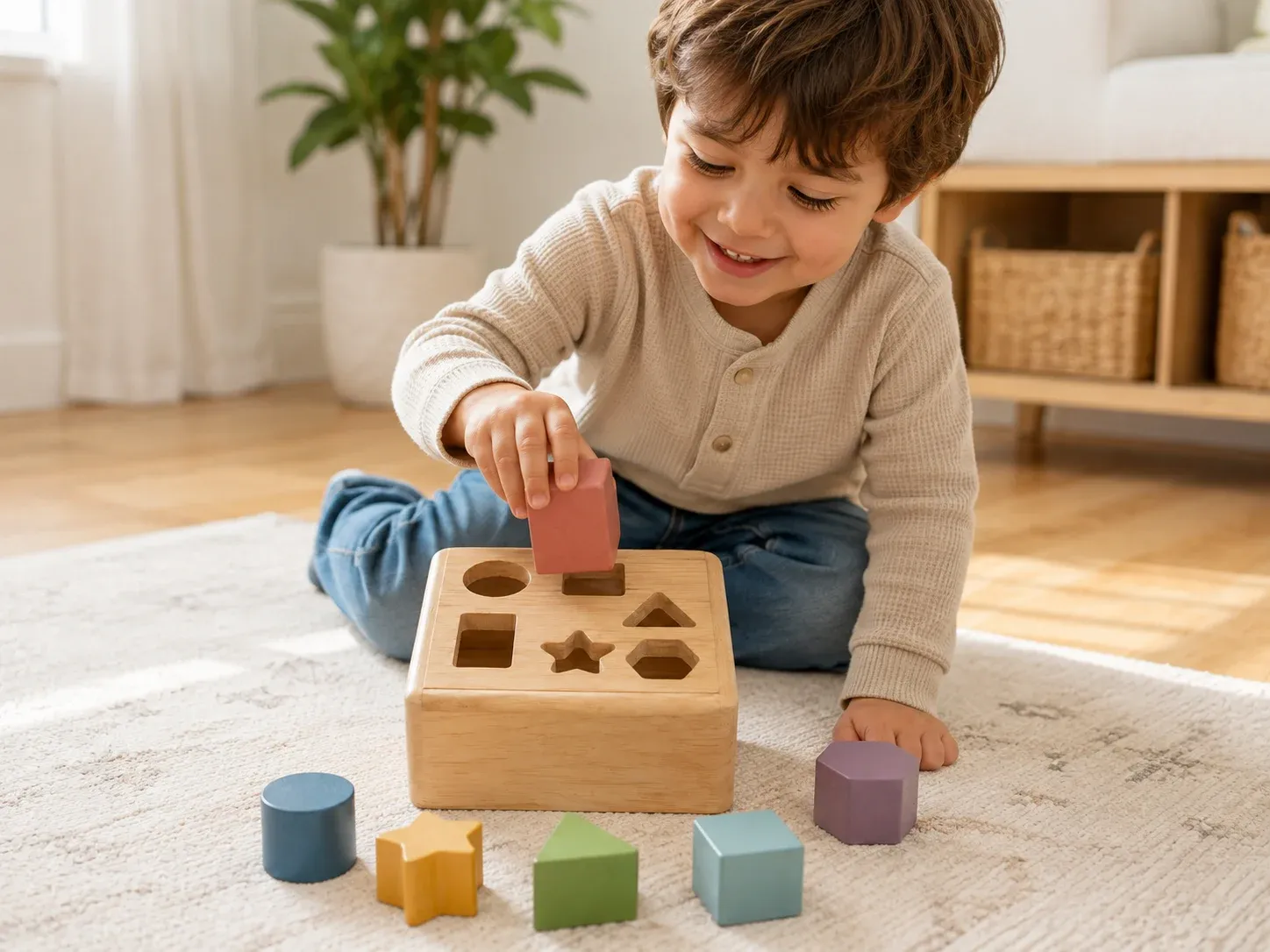
A shape sorter looks simple.
There are several blocks, several openings, and one basic problem: which piece fits where?
For a toddler, that small problem can contain a surprising amount of work.
The child has to look at the block, compare it with the available openings, move the hand toward a target, adjust the angle, apply pressure, and decide what to change when the first attempt does not work.
Sometimes the shape is wrong.
Sometimes the correct opening has been chosen but the piece is rotated the wrong way.
Sometimes the box itself moves and makes the task harder.
That is why shape sorters can remain interesting even though their design is straightforward.
They create a physical problem that children can repeat as many times as they want.
The main question is simple: does this fit?
A toddler picks up a round piece and pushes it toward a square opening.
It does not go through.
They push again.
Still no.
Then they try another slot.
Eventually, the piece drops inside.
The toy gives feedback without needing a score, a sound effect, or an adult saying “correct.”
The physical relationship provides the answer.
This makes shape sorting a natural form of trial and error.
Children can test an idea, see what happens, and adjust.
The adult’s role does not have to be giving the answer immediately.
Matching shapes is more than memorizing names
Parents often think of shape sorters as toys for teaching circles, squares, and triangles.
Naming shapes can certainly become part of the experience.
But children can learn from the physical differences before they know the vocabulary.
A cylinder behaves differently from a cube.
A triangle has corners that affect how it lines up with an opening.
A round piece may roll.
A block with flat sides may stack.
The child does not need to say “triangle” correctly for the activity to matter.
The spatial relationship comes first.
The word can be added naturally later.
Rotation is one of the hidden challenges
A child can select the correct opening and still fail to insert the block.
The reason may be orientation.
The piece needs to turn.
That creates a useful problem.
The child rotates the block in the hand.
Checks again.
Moves it slightly.
Tries another angle.
This is one of the most interesting parts of shape sorting because it teaches that the same object can relate differently to space depending on how it is positioned.
Adults can support this with simple language:
“Try turning it.”
“The shape is right, but the angle is different.”
Then wait.
The important movement still belongs to the child.
Hand-eye coordination appears in every attempt
Inserting a shape involves several coordinated actions.
The child picks up the block.
Moves it toward the opening.
Slows down near the target.
Adjusts the wrist.
Aligns the piece.
Pushes gently.
If the position changes, the child corrects it.
These movements become smoother with familiarity.
At first, a child may use large arm movements.
Later, the hand and wrist do more precise adjustment.
The improvement happens through repetition rather than through one perfect attempt.
Different shapes invite different grips
A child may hold a large cube with the whole hand.
A narrow piece may be controlled more with the fingers.
A cylinder may be easiest to grip from the side.
A triangular piece can encourage the child to reposition the hand several times.
That variety gives the hands different kinds of work.
But smaller is not automatically better.
Pieces should be large enough for the intended age group and comfortable to handle.
For children who still mouth objects, small components can create a serious hazard.
Age guidance matters more than the idea that tiny pieces somehow create “advanced” learning.
Trial and error is not a sign that the child does not understand
Toddlers often try the same wrong opening several times.
Adults may feel the urge to correct every attempt.
“No, not there.”
“The circle goes here.”
If the answer is always supplied immediately, the activity becomes faster but less exploratory.
Pause first.
See whether the child changes strategy.
They may notice the mismatch independently.
If help is needed, offer a small clue.
“That one doesn’t seem to fit.”
“Can you find an opening that looks more like it?”
If the child is becoming frustrated, narrow the choices rather than completing the task for them.
Help should make the problem manageable, not disappear
Useful assistance can be very small.
Hold the sorter steady.
Turn the box so the relevant side is easier to see.
Offer two possible openings instead of six.
Demonstrate one shape and return the next one to the child.
Partially rotate a piece and let the child finish.
These approaches preserve the child’s role.
The adult supports the process without becoming the person who solves every difficult slot.
Difficulty should match the child
Shape sorters vary widely.
Some have only a few basic openings.
Others have many sides, complex shapes, colors, numbers, doors, gears, and other activities.
More features do not automatically create more useful play.
For a child who is just learning the idea of matching a shape to an opening, a simpler design may be easier to understand.
Once the basic relationship is familiar, more varied shapes can add challenge.
The goal is not to buy the most complicated sorter.
It is to choose one that gives the child a problem they can actually work on.
Signs a sorter may be too difficult
Watch how the child uses it.
If almost every attempt ends with the child handing the piece to an adult, the challenge may be too high.
If a correct piece needs excessive force, the problem may be the construction rather than the child’s skill.
If the block is awkward to hold, it may not suit the child’s hand.
If the box has so many openings that the child cannot visually scan them, a simpler design may work better.
A useful toy should be challenging because of the matching task, not because it is poorly fitted or overly complicated.
When the sorter becomes easy
Eventually, a child may place each shape quickly.
That does not mean the toy has to disappear immediately.
Some children enjoy repeating familiar actions.
Parents can also extend the play lightly.
Turn the sorter around so the usual openings appear in a new position.
Ask the child to find one particular shape.
Compare which pieces roll.
Use the blocks for stacking or pretend play.
Or simply leave the toy available until interest fades.
Not every successful activity needs to be made harder right away.
Spatial language can grow naturally
Shape sorting creates useful opportunities for words related to space.
Round.
Corner.
Side.
Inside.
Outside.
Next to.
Above.
Below.
Wide.
Narrow.
Turn.
Fit.
Adults can model these words while the child plays.
“The opening is on the side.”
“This one has corners.”
“You turned it and now it fits.”
The child does not need to answer a question every time.
Hearing spatial words attached to a visible action is often more natural than turning the session into a naming quiz.
Avoid making every shape a test
“What shape is this?”
“Where does the triangle go?”
“What color is the circle?”
Those questions are fine occasionally.
But if every piece requires an answer before the child can continue, play can start to feel like assessment.
Adults can describe instead.
“You chose the round one.”
“The triangle isn’t lined up yet.”
“The cube went inside.”
Language still enters the activity without requiring the child to perform for the adult.
The pieces can be explored outside the box
If the components are age-appropriate and safe to use separately, the blocks can support more than matching.
Which ones roll?
Which stand easily?
Which stack?
Which feel heavier?
Which have flat sides?
Children may line them up, build with them, carry them in containers, or use them as pretend food.
Those alternative uses do not ruin the educational purpose.
They often extend the life of the material.
Children may prefer the big opening—and that is okay
Some sorters have a lid or door that opens so children can retrieve the pieces.
Toddlers often discover that the large access opening is an easier way to put every block inside.
Adults may see that as “cheating.”
The child may be exploring a different set of ideas.
Open and closed.
In and out.
Full and empty.
Put in and take out.
Parents can still demonstrate shape matching, but there is no need to prevent every alternative use if it is safe.
Interest in the smaller matching openings may come later.
Getting the pieces back out is part of the experience
A sorter needs a reset mechanism.
The child puts pieces in, opens the box, empties them, and begins again.
If retrieving the blocks is too difficult, adults have to reset the toy after every round.
That can interrupt independent repetition.
When choosing a sorter, look at how the child gets the pieces back.
Is the lid manageable?
Does a door open safely?
Can the child tip the box without it being excessively heavy?
A good reset process makes repetition easier.
Stability affects the quality of the task
A sorter that slides across the floor every time a block is pushed creates unnecessary difficulty.
The child should be working on alignment, not chasing the box.
Look for reasonable stability on the surface where it will be used.
Weight can help, but heavier is not always better.
A very heavy sorter may be difficult for the child to move or reset.
The useful balance is stable enough during play but still manageable for the intended user.
Wood can be appealing without being automatically superior
Wooden shape sorters are often chosen for their feel, weight, appearance, and durability.
Those can be meaningful qualities.
But wood alone does not guarantee a better toy.
A wooden sorter can still have rough edges, poor fitting, weak joints, or an unsuitable finish.
A well-designed sorter made from another material can also provide excellent play.
Look at the whole product.
Construction, age suitability, fit, surface quality, maintenance, and stability matter more than the material label by itself.
Precision matters because the toy depends on accurate fit
A shape sorter relies on the relationship between each block and its opening.
If the slot is too tight, the correct shape may still fail.
That gives the child confusing feedback.
If the opening is too loose, several pieces may pass through when they should not.
The fit should be accurate enough that the child can trust the result.
When the shape and orientation are correct, the piece should go through without unreasonable force.
This is one reason manufacturing quality matters for a matching toy.
Check surfaces, edges, and moving parts
Toddlers handle shape sorters from every side.
They rotate the box.
Knock pieces against it.
Carry it.
Reach through openings.
Open lids.
Check the product periodically.
Look for cracks, rough patches, splinters, loose parts, damaged coatings, or hinges that have changed condition.
Follow the manufacturer’s care guidance.
If damage creates a sharp edge, loose small component, or other safety concern, stop using the toy until it can be repaired appropriately or replaced.
Consider finger access and pinch points
Openings should not only fit the blocks.
They should also make sense for how children actually use the toy.
Toddlers may put fingers into slots.
Reach through larger openings.
Hold the lid while closing it.
Explore hinges.
Look at whether the design creates obvious pinch areas or awkward gaps.
Children do not always use products exactly as adults expect.
A good design accounts for curious hands.
The “Montessori” label is not the main quality test
Shape sorters are frequently marketed as Montessori toys.
The label itself says little about whether the product is appropriate for a particular child.
Look instead at what the toy allows the child to do.
Can they manipulate the pieces independently?
Is feedback clear?
Is the design visually understandable?
Are the parts securely made?
Is the challenge suitable for the age group?
A well-designed product can be useful whether or not the word Montessori appears in the title.
Electronic toys do not need to be the enemy
A simple sorter has a clear advantage: the relationship between action and result is easy to see.
The child moves the block.
It fits or it does not.
There is little extra stimulation competing with that physical problem.
But that does not mean every electronic toy creates passive play.
Different toys offer different experiences.
Parents do not need to justify a shape sorter by criticizing every product with lights or sounds.
The better question is whether the toy gives the child something meaningful to do.
More features can sometimes make the main idea less clear
Some shape sorters combine matching holes with clocks, gears, number panels, mazes, laces, or other activities.
That can be useful for some children.
For others, the main matching task becomes harder to read.
A simple sorter has one strength: the relationship between block and opening is obvious.
If families want several kinds of fine motor play, those activities do not all need to be built into one product.
A puzzle can be a puzzle.
A busy board can be a busy board.
A shape sorter can focus on fitting and orientation.
Storage helps keep the set usable
Shape-sorter pieces are easy to lose.
If the sorter itself stores the blocks, use that feature.
Otherwise, keep all components in one small basket or container.
The system does not need to be complicated.
Children can help return pieces after play.
A complete set makes matching easier, but losing one piece does not always make the entire toy useless.
The important thing is that the remaining pieces can still be used safely.
Clean according to the material
Toddler toys receive frequent hand contact.
Clean the sorter according to the manufacturer’s instructions.
Do not soak wooden parts unless the product specifically allows it.
Dry pieces thoroughly before storing them.
Cleaning is also a good time to inspect condition.
Check whether a coating is peeling, a joint is loose, or a piece has cracked.
Durability should be observed in real use, not assumed from marketing claims.
Not every child will love shape sorting
Some toddlers enjoy matching the same pieces again and again.
Others lose interest quickly.
That is normal.
Children can practice hand-eye coordination, spatial thinking, and problem solving through many other activities.
Blocks.
Puzzles.
Containers.
Stacking toys.
Pretend play.
Daily routines.
A shape sorter is one option, not a developmental requirement.
If the child is not interested, put it away and try again later rather than turning it into a task they must complete.
Completion is not the only sign of useful play
A child does not need to insert every piece before the session “counts.”
They may work with two shapes and then leave.
Empty the box repeatedly.
Stack the pieces.
Carry them around the room.
That can still be meaningful.
The important part is the interaction: looking, comparing, moving, adjusting, and deciding what to do next.
A completed sorter is satisfying, but it is not the only worthwhile outcome.
A practical way to choose a shape sorter
When comparing products, look beyond the number of shapes or the word “educational.”
Consider:
- the manufacturer’s age guidance,
- the size of the pieces,
- how easy they are to grip,
- the precision of block-to-opening fit,
- the stability of the base,
- edge and surface quality,
- the way children retrieve the pieces,
- the security of joints and moving parts,
- the clarity of material information,
- and how realistic the product is to clean and store.
The best sorter is usually not the one with the longest feature list.
It is the one whose challenge is clear enough for the child to understand and repeat. Read more about why fine motor play deserves more attention, explore how Montessori busy boards nurture toddler independence, and review our guide on 10 things to check before choosing educational toys.
Recommended Serious Fun Shape Sorter Toys
Nurture spatial logic and problem-solving with Serious Fun’s shape sorting sets:
- Wooden Shape Sorter: Handcrafted mahogany & pine sorting box with 12 precision-cut geometric blocks.
- Sensory Activity Cube: Multi-sided wooden activity cube featuring shape sorting, spinning gears, and wire maze.
Conclusion
A wooden shape sorter remains useful because it presents a very simple physical question:
Does this object fit into this space?
To answer it, a child has to look, compare, grasp, rotate, align, push, fail, and try again.
That process can involve hand-eye coordination, spatial language, orientation, fine motor control, and simple problem solving.
The value does not come from wood being automatically superior, from the toy carrying a Montessori label, or from promising a particular developmental milestone.
It comes from the quality of the interaction.
Choose a well-constructed, age-appropriate product.
Give the child time.
Help only as much as needed.
And if they decide the blocks are better used for stacking, carrying, or pretend cooking for a while, that is part of play too.
A good shape sorter does more than lead children toward the “correct hole.”
It gives them repeated chances to discover how objects, hands, and space relate to one another.
