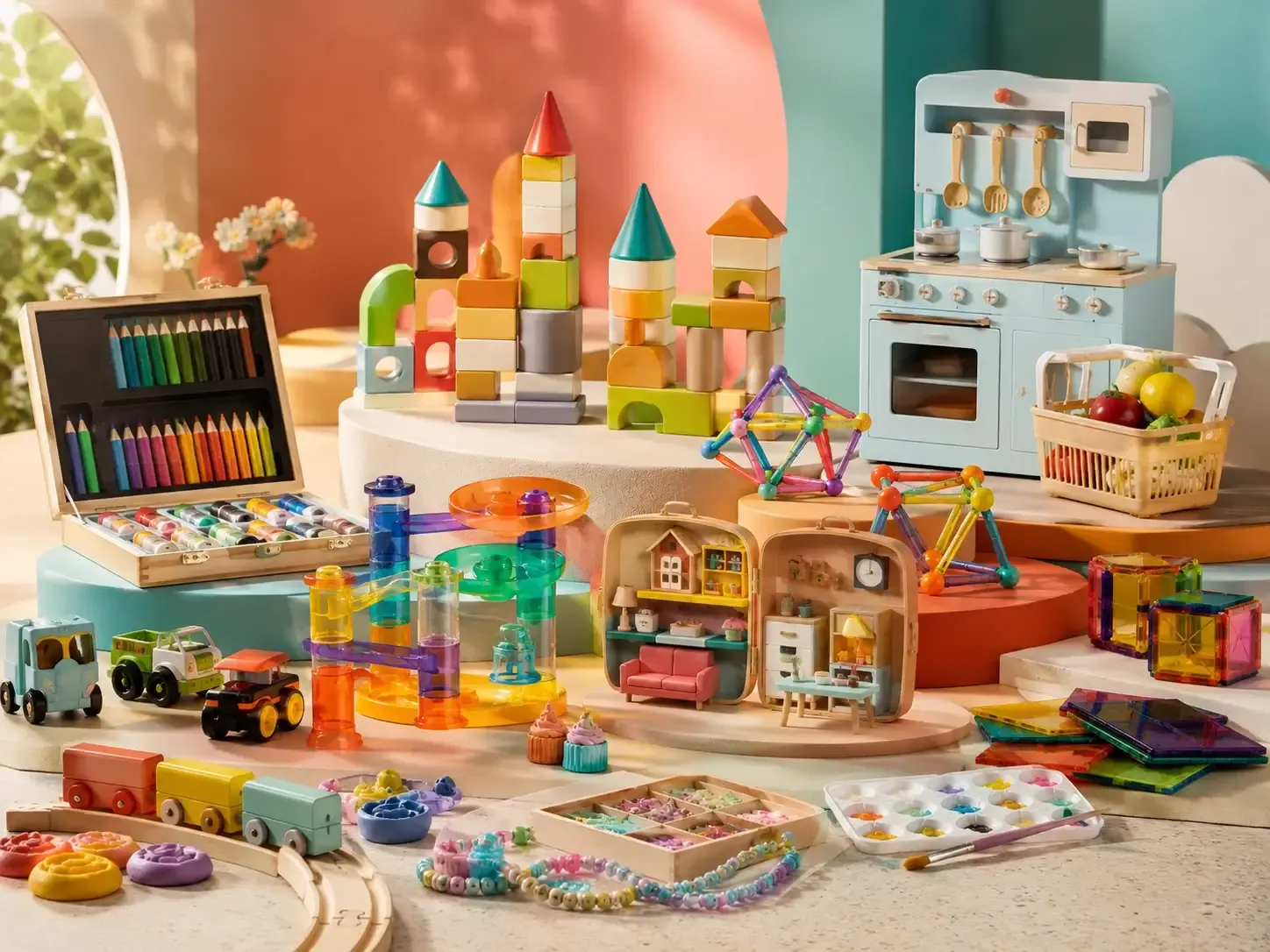
Open-ended play does not have one correct ending.
A child can stack, dismantle, combine, rename, rebuild, invent characters, change the rules, and begin again with a completely different idea.
A block does not have to remain a block. It can become a phone, a loaf of bread, a bridge, a ticket, a bed for a toy animal, or part of a spaceship.
A piece of fabric can be a blanket one minute and a river the next.
A cardboard box can become a shop, a car, a house, or simply a container for everything the child has decided belongs in today’s story.
That flexibility is what makes open-ended play valuable.
The toy or material does not determine every step. The child contributes much of the meaning.
Open-ended does not mean aimless
Open-ended play can look unstructured from the outside, but children often have very clear goals.
They may want to build a garage large enough for three cars.
Create a house for several figures.
Make a restaurant where every stuffed animal gets a meal.
Build a bridge across a pretend river.
The difference is that the goal comes from the play rather than being completely defined by the product.
A puzzle usually has a particular solution.
A block set can become hundreds of different things.
Both types of play can be useful.
Goal-based toys can support persistence, matching, sequencing, and other specific tasks. Open-ended materials give children more room to decide what the problem is in the first place.
A balanced play environment can include both.
Imagination grows when an object leaves room for interpretation
Highly detailed toys can create wonderful pretend play.
A toy fire truck clearly suggests firefighting. A doctor’s kit suggests a clinic. A miniature kitchen suggests cooking.
More neutral materials offer a different kind of opportunity.
They make the child decide what something represents.
A rectangular block might become a phone because the child holds it to their ear.
Later it becomes a sandwich.
Then a bed for a figure.
The physical object has not changed. Its symbolic role has.
This kind of symbolic play is one way children practice separating what an object literally is from what it can represent inside a story.
Adults do not need to teach that concept directly.
They can simply leave room for children to assign new meanings.
One object can change roles several times in a single play session
Open-ended play is often fluid.
A cloth begins as a blanket for a doll.
Then two chairs become a tent, and the cloth becomes the roof.
The tent turns into a boat.
Now the cloth is a sail.
Nothing new was purchased or introduced.
The context changed.
That ability to reinterpret familiar material helps play continue without requiring constant novelty.
Children learn that the same object can support different ideas depending on what the story needs.
Small decisions give children ownership
Open-ended play is full of choices.
Which block goes first?
Who lives in this house?
Is this a shop or a school?
Does the road go under the bridge or beside it?
Who gets the red cup?
What happens after the tower falls?
Each decision may look minor to an adult.
Together, they make the play feel like the child’s own work.
There is no adult continuously telling them what comes next.
There is no button producing the same result every time.
The child sees that their choices change the direction of the activity.
That sense of ownership can make a familiar material interesting for much longer.
Trial and error feels less like failure
In a fixed task, mistakes are often easy to identify.
The puzzle piece does not fit.
The sequence is wrong.
The answer is incorrect.
Open-ended play has looser boundaries.
If a tower falls, the child can rebuild it.
Or the fallen blocks can become a road.
If a roof is too small, the child can add another piece.
If the pretend restaurant runs out of plates, a block can become a plate.
Unexpected results can become part of the story.
This makes experimentation feel lighter.
The child can revise the plan instead of feeling that they failed to reach one required outcome.
Problem solving appears because the child’s idea creates a need
Open-ended play is not only about fantasy.
Once a child has an idea, practical problems begin appearing.
The garage is too small.
The bridge does not reach.
The roof keeps sliding off.
There are four customers but only three cups.
A toy animal will not fit through the doorway.
These problems matter to the child because they interfere with the story.
That creates motivation to solve them.
The child may change the structure, substitute another object, divide materials differently, or rewrite the rule.
The solution does not need to match what an adult would choose.
The thinking happens because the child is trying to make their own idea work.
Plans can change without ruining the play
Children rarely follow one storyline from beginning to end.
A house becomes a station.
A zoo becomes a rescue center.
A tower becomes a rocket.
An animal figure suddenly becomes the shopkeeper.
Adults may interpret constant changes as a lack of focus.
Often, the child is doing something more interesting: adapting the play to new ideas.
A toy appears.
A sibling says something.
A structure falls.
A memory from yesterday enters the story.
Open-ended play gives children permission to revise rather than forcing them to preserve the original plan.
Pretend stories do not have to make adult sense
Children’s imaginary worlds have their own logic.
Dinosaurs can work in cafés.
Cars can sleep.
Soup can be made from stones.
A cardboard box can fly to the moon.
Adults do not need to correct every unrealistic detail.
Pretend play works because everyone temporarily accepts that one thing can stand for another.
If a child says a block is a birthday cake, there is little value in replying, “But that is actually a block.”
A more useful response might be:
“Who is the cake for?”
The adult follows the child’s meaning rather than pulling the story back to reality.
Language grows because children need to explain the world they created
Open-ended play often produces language naturally.
A structure may not be obvious to anyone else.
The child needs to explain:
“This is the hospital.”
“The red part is the door.”
“Cars can’t go here because the road is flooded.”
In shared play, communication becomes even more important.
Children explain rules.
Assign roles.
Protect parts of a project.
Ask for materials.
Negotiate what happens next.
Language is not being practiced in isolation. It is being used to make the shared imaginary world understandable.
Stories become longer over time
Young children may begin pretend play with a single repeated action.
A doll eats.
A car drives.
A figure sleeps.
Over time, one event can become a sequence.
The doll gets hungry, goes to a café, discovers there is no food, visits the market, returns, and eats with friends.
The car starts a trip, finds the road blocked, visits a repair shop, and takes a new route.
Open-ended materials support this growth because they do not stop being useful after one action.
The same blocks can become the café, market, roadblock, and repair shop.
Loose parts give children raw material for ideas
Loose parts are objects that can be moved, combined, stacked, arranged, separated, and reused in different ways.
For children, those materials still need to be age-appropriate and safe.
Examples might include blocks, large rings, fabric pieces, containers, figures, boards, or other objects designed or selected for play.
Their value comes from flexibility.
Children do not only play inside a world already designed by a manufacturer.
They build part of the world themselves.
A basket becomes a boat.
A cloth becomes water.
Blocks become a dock.
Figures become passengers.
The relationships between the objects come from the child’s idea.
Everyday objects can support rich pretend play
Open-ended play does not require a large collection of specialized toys.
Cardboard boxes are a classic example because they are so easy to reinterpret.
Fabric, safe containers, paper tubes, cushions, and other household materials can also become part of play.
Safety still matters.
A household object is not automatically suitable for children just because it is already in the home.
Avoid sharp edges, breakable materials, long cords, small detachable parts for children who may mouth objects, and anything else that does not fit the child’s age or way of exploring.
Simple materials are useful when they are also appropriate.
Children do not always need an idea from an adult
When a child looks at a pile of blocks and does nothing for a moment, adults often rush to help.
“Let’s make a house.”
“Build a tower.”
“Why don’t you sort the colors?”
Sometimes a suggestion is helpful.
Other times, the child is still deciding.
A few quiet moments can be productive.
If adults provide the idea every time there is a pause, children may begin waiting for external direction.
Open-ended play benefits from a little empty space.
Not every moment needs to be filled immediately.
Familiarity can deepen play
New toys can be exciting.
Familiar toys have another advantage.
The child already knows their weight, size, and possibilities.
They know which block makes a good bridge.
Which container fits the figures.
Which cloth covers two chairs.
That knowledge frees attention for more complex ideas.
Creativity does not always depend on novelty.
Sometimes it grows because the child knows the material well enough to use it more fluently.
Playing alone and playing together offer different experiences
Solo open-ended play gives the child control over the entire story.
They decide the pace, rules, and direction.
Shared play introduces negotiation.
Two children may have different ideas for the same structure.
One wants a zoo.
The other wants a school.
Now they need to communicate.
They might divide the space, combine ideas, take turns, or argue.
Disagreement does not automatically mean the play has failed.
Social problem solving often appears precisely because the material does not tell everyone what role they must take.
Siblings of different ages can use the same material differently
An older child may build an elaborate city while a younger sibling stacks only two blocks.
That is fine.
Open-ended materials can support different levels of complexity at the same time.
The younger child may carry figures.
The older child creates dialogue.
They do not need to perform the same activity.
Safety still needs to match the youngest user in the space, especially when a set contains smaller components.
Open-ended does not mean universally age-appropriate.
Parents can join without taking over
Open-ended play does not require adults to stay completely outside the activity.
Many children enjoy inviting parents into the story.
The key is to join as a participant rather than the director.
Ask:
“Who am I?”
“Where should my shop go?”
“Can I use this block?”
“What does my character need to do?”
These questions let the child remain the main author.
If the adult always builds the stronger bridge, improves the house, or decides the storyline, the play gradually becomes an adult project.
Not every open question is helpful
“What are you making?” can be supportive.
Asked every two minutes, it can become tiring.
Sometimes the child does not know yet.
They are simply arranging pieces.
Adults can comment instead.
“You put all the long blocks on this side.”
“The cars moved upstairs.”
“You rebuilt that part after it fell.”
Comments show attention without requiring the child to explain every action.
If they want to elaborate, they will.
Open-ended play can be noisy and messy
Photos of open-ended play often show beautiful shelves and carefully arranged wooden materials.
Real play may look very different.
Blocks spread across the floor.
Fabric hangs over chairs.
Figures fill a cardboard box.
A “train” takes over half the room.
That is normal.
A home still needs boundaries, but the goal is not to preserve a showroom.
Children are using the materials.
The setup should be able to survive that.
Freedom still needs boundaries
Open-ended does not mean rule-free.
Children can decide whether a block is a cake or a phone.
Adults still decide whether blocks may be thrown.
Fabric can become a tent, but not in a place that creates a safety problem.
Furniture can join pretend play only in ways that are safe for the child’s age and environment.
Clear physical boundaries make creative freedom easier to manage.
Children know which parts of the play they control and which limits remain fixed.
A small amount of material can be enough
Children do not need an entire room of loose parts.
A manageable collection can include a few broad categories:
- blocks or construction pieces,
- figures,
- fabric,
- containers,
- vehicles,
- drawing materials,
- simple pretend-play props.
Not everything needs to be available at once.
A smaller selection can make individual materials easier to notice.
When something is missing, children may also invent substitutions.
No fourth plate?
Perhaps a flat block can work.
A small limitation can become part of the problem solving.
Open-ended toys do not have to be wooden or neutral-colored
Open-ended play is sometimes associated with natural wood, muted colors, and a particular interior style.
That is an aesthetic choice, not a requirement.
Plastic blocks can be open-ended.
Cardboard can be open-ended.
Magnetic construction pieces, fabric, clay, art materials, and figures can all support flexible play when they are appropriate for the child’s age.
The important question is not what the toy looks like on a shelf.
It is how much room the child has to decide what it becomes.
Some children need a starting point
Not every child immediately knows what to do with open-ended materials.
That does not mean they lack imagination.
They may be more comfortable with a small invitation.
“The cars don’t have a garage.”
“These animals need somewhere to sleep.”
“We have a cloth and two chairs. What could we make?”
Once the child begins, step back.
A starting prompt is different from giving step-by-step instructions.
The goal is to open the door, not determine the finished result.
Save unfinished projects when practical
Open-ended play often produces projects that children want to continue.
A city is still under construction.
The restaurant is still “open.”
The animal habitat needs another section.
If every project must disappear immediately, children lose the chance to return and revise.
When space allows, create one small save spot.
A tray.
A low shelf.
A table corner.
Not everything needs to stay.
A limited save area creates a useful compromise between preserving play and keeping the home functional.
Storage should make combining materials easy
If every toy must remain in its original set, children may be less likely to combine ideas.
Simple categories are often enough.
Blocks together.
Figures together.
Fabric in one basket.
Pretend-play accessories in another.
The child can still mix them during play and knows roughly where they return afterward.
A storage system should support play, not make cleanup so complicated that only adults can manage it.
Creativity does not need to look original every time
Children often copy ideas.
They build the same kind of house a friend built.
Repeat a restaurant story they have seen before.
Make the same tower several days in a row.
That is not the opposite of creativity.
New ideas often grow from familiar ones.
The child changes one detail.
Adds a character.
Builds it larger.
Combines two stories.
Creativity can be gradual.
Not every play session needs to produce something no one has ever seen.
Open-ended play should not become a developmental requirement
Open-ended play can offer many useful experiences, but it does not need to become another standard children are expected to meet.
Some days a child may prefer a puzzle with one correct solution.
Or a book.
Or movement play.
Or a familiar electronic toy.
That does not make the play less valid.
Open-ended play is one valuable option among many.
It works best when it remains an invitation rather than a test of whether a child is “creative enough.” Learn more about open-ended building blocks for spatial skills, how play kitchens encourage language development, and our guide on rotating toys without limiting play.
Recommended Serious Fun Open-Ended Toys
Inspire limitless creative play with versatile wooden toys from Serious Fun:
- Creative Building Blocks: 50 solid FSC-certified wooden blocks designed for endless architectural and symbolic play.
- Pretend Play Kitchen Set: Versatile wooden roleplay kitchen that transforms into restaurants, bakeries, or market stalls.
Conclusion
Open-ended play matters because it gives children room to contribute more of the meaning.
They decide what an object represents.
They create the problem.
They change the rule.
They rebuild when something fails.
They explain the story to someone else.
The materials do not need to be elaborate.
Blocks, fabric, figures, containers, cardboard, and other age-appropriate objects can offer plenty of possibility.
Adults can support the process by providing safe materials, allowing some mess, setting clear boundaries, following the child’s story, and resisting the urge to supply every idea.
A great open-ended toy does not need to do very much on its own.
Its strength is the space it leaves for the child to do the imagining.
