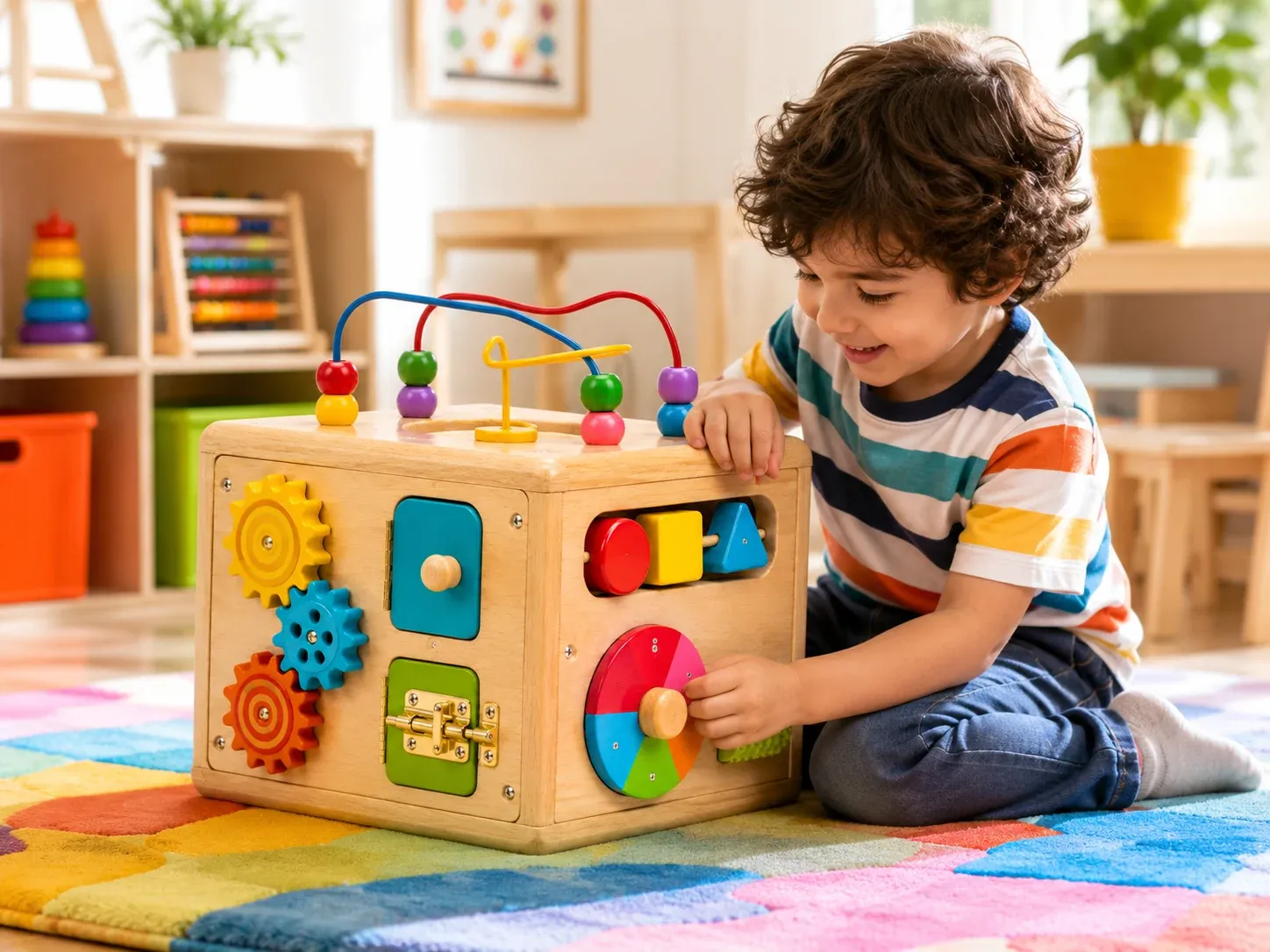
Fine motor development often happens quietly.
There is no dramatic jump or sprint to notice. Instead, progress shows up in small moments: a child rotates a puzzle piece, presses two parts together, opens a container, pinches a piece of dough, threads something onto a cord, or keeps adjusting a block until it finally sits where they want it.
These actions can look simple from the outside.
For the child, several things are happening at once. The eyes estimate position. The hand moves toward a target. Fingers adjust pressure. The wrist changes angle. One hand may hold something steady while the other performs the more precise movement.
And when the first attempt does not work, the child has another decision to make: try again, change the grip, rotate the object, use the other hand, or ask for help.
That is why fine motor play deserves more attention. Not because children need to rush toward handwriting or dressing independently, but because hand control develops through hundreds of small experiences long before those skills become important.

Fine motor skill is more than finger strength
Fine motor development is often described as strengthening small hand muscles.
That is only part of it.
Putting a puzzle piece into place can require visual attention, wrist rotation, finger control, posture, and timing.
Pouring from one container to another requires the child to tilt gradually rather than dump everything at once.
Threading requires one hand to hold the cord while the other finds the opening.
Opening a lid can involve gripping, twisting, stabilizing, and adjusting pressure.
The hand is not working alone.
Fine motor control grows through coordination between vision, hands, wrists, arms, and the position of the rest of the body.
Hands often understand before children can explain
Young children learn a great deal through movement.
They discover that one block is heavier by lifting it.
They notice that two pieces do not connect until one is rotated.
They learn that dough changes shape when they press harder.
A child may not be able to explain why a shape does not fit, but their hands begin trying different orientations.
That is already a form of problem solving.
Physical materials offer immediate feedback.
The piece fits or it does not.
The tower stays up or falls.
The lid opens or remains stuck.
The water lands in the cup or spills over the side.
Children can learn from those outcomes before they have the language to describe what happened.
Hand-eye coordination grows through ordinary play
Reaching for a small object requires the child to judge distance.
Placing a ring onto a post means aligning two positions.
Stacking blocks requires the hand to stop at a reasonably precise point before releasing.
With repetition, children often become more efficient.
Early movements may involve the whole arm.
Later, the wrist and fingers do more of the work.
That change is gradual.
Parents often notice it most clearly when they compare how a child handles the same familiar activity several months apart.
Two hands often have different jobs
Many everyday tasks require both hands, but they do not necessarily do the same thing.
One hand holds the paper while the other draws.
One hand steadies a container while the other twists the lid.
One hand holds a cord while the other threads a bead.
One hand grips the jacket while the other pulls the zipper.
This kind of cooperation is often called bilateral coordination.
Parents do not need to teach the term.
They can simply offer activities that naturally require both hands.
Tearing paper, opening boxes, working with dough, threading, fastening, and building structures that need one piece held while another is added all create useful two-handed practice.
Repetition helps movements become more efficient
A child may put objects into a container and take them out again dozens of times.
Adults can wonder why the activity is still interesting.
For the child, each repetition gives the body another opportunity to refine the movement.
The first attempt may be slow.
The next may need less force.
Later, the child begins anticipating the angle or position before acting.
The same process appears in puzzles, stacking toys, peg boards, fastening activities, pouring, and many other forms of hands-on play.
Repetition is not necessarily a lack of imagination.
Sometimes the child is simply practicing until a movement feels easier.
The right level of challenge matters
An activity that is too easy may lose interest quickly.
An activity that is far too difficult can leave the child unsure where to begin.
The most useful challenge is often somewhere in between.
The child can almost do it.
A puzzle piece is close to fitting.
A buckle needs another adjustment.
A stacking toy is stable enough to try but not so easy that every arrangement works.
Watch what the child does.
If they keep experimenting and changing strategies, the challenge may be appropriate.
If they immediately hand the task to an adult every time, the material may need to be simplified.
A little frustration can be useful, but endless frustration is not
Fine motor play often includes moments when something refuses to work.
The bead misses the cord.
The tower falls.
The lid will not turn.
The zipper catches.
Adults do not have to solve the problem instantly.
Pause and see what the child tries next.
If help is needed, give the smallest useful amount.
Hold the container steady.
Start the zipper.
Loosen the lid slightly.
Turn the puzzle piece partway.
Then return the important movement to the child.
The goal is not to make children struggle for the sake of struggle.
It is to give them enough support that they can still experience, “I did the main part.”
Focus often appears when the hands have a clear job
Children do not always need to be told to concentrate.
Attention can emerge when an activity gives the hands something concrete to do.
Move all the pieces into the container.
Finish one puzzle.
Pour water into two cups.
Build a road from these blocks.
Connect the construction pieces.
A clear physical goal gives attention somewhere to go.
But fine motor play should not become a test of attention span.
Children differ in how long they stay with an activity, and interest, age, environment, tiredness, and difficulty all affect that time.
Stacking teaches more than “up”
Placing one object on top of another requires control.
Release too early and it lands in the wrong place.
Push too hard and the structure shifts.
Move too quickly and the tower may fall.
Blocks, stacking cups, and other age-appropriate construction materials let children practice controlled placement.
The result is easy to read.
A stable structure gives one kind of feedback.
A collapse gives another.
Adults often do not need to correct anything.
The structure has already shown the child what happened.
Pinching and grasping are different kinds of work
Some fine motor toys are built around small pinching movements.
Others require a fuller hand grip.
Both can be useful.
Large tongs or child-sized tweezers can make transferring objects into a game, but only if the tool fits the child’s hand and is not excessively stiff.
For a younger child, using fingers directly may be more appropriate.
There is no need to rush toward smaller tools simply because they look more advanced.
The challenge should come from controlling the movement, not from fighting an awkward tool.
Threading combines precision with two-handed coordination
Threading activities bring several movements together.
One hand holds the cord.
The other picks up the piece.
The eyes find the opening.
The child keeps the piece oriented while pushing the cord through.
Then the hands adjust again to pull it along.
For younger children, large age-appropriate components and a relatively stiff cord can make the activity easier to understand.
A child does not need to create a long necklace or complex pattern.
Threading only a few pieces already provides meaningful practice.
Puzzles are also hand activities
Puzzles are often treated as purely cognitive toys.
The hands do a great deal of work too.
Children pick up a piece, rotate it, flip it, align it, lower it, and adjust again when it does not fit.
Knob puzzles add a different grip.
Simple inset puzzles may offer clear boundaries.
More complex puzzles require the child to compare several possible positions.
Adults can use light spatial language:
“Try turning it.”
“The straight side is over here.”
“The corner isn’t lined up yet.”
But avoid pointing to the correct place every time.
Leave room for the child to search.
Playdough creates many hand movements without one required result
Dough is useful because children can squeeze, pinch, roll, flatten, pull, press, and cut it.
Each action uses force differently.
Simple age-appropriate tools can add more variation: a small rolling pin, cutters, or blunt play tools.
There is no requirement to make a recognizable object.
A child who spends ten minutes rolling and squashing the same piece is still getting useful hand practice.
The process matters more than whether the result looks impressive.
Opening and closing containers can be surprisingly engaging
Many children are fascinated by lids.
They open a box.
Close it.
Open it again.
Put something inside.
Take it out.
Containers can offer excellent fine motor practice when they are safe and age-appropriate.
Start with simple mechanisms.
A loose lid.
A flip top.
A box that pulls open.
Later, children may be ready for lids that twist or require more precise alignment.
Avoid breakable containers, sharp edges, and small detachable parts.
The attraction often comes from the clear outcome: open or closed.
Pouring builds gradual control
Pouring looks simple because adults do it automatically.
For a child, the movement requires several adjustments.
Lift the container.
Aim.
Tilt gradually.
Watch the flow.
Stop before overflowing.
Practice can begin with empty containers in pretend play or with small amounts of water in a supervised setting.
Container size matters.
A jug that is too heavy makes the activity difficult for reasons unrelated to fine motor control.
Use tools the child can handle comfortably.
Scooping adds another kind of directional control
Moving objects with a spoon requires a different strategy from moving them by hand.
The spoon has to stay level enough to carry the item.
The child has to aim for the second container.
If the opening is narrow, the movement becomes more precise.
Two bowls and a few age-appropriate objects can be enough. The child should do the movement rather than only watch an adult demonstrate it.
Scissors require readiness and supervision
Scissor use adds another layer of complexity.
Children must repeatedly open and close the tool while guiding it through material.
Use child scissors designed for the intended age and supervise appropriately.
Start with easy cutting rather than demanding precise lines.
Simply learning the open-close motion may be enough at first.
If the child is not ready or interested, there is no need to push.
Many other activities can offer fine motor practice without a cutting tool.
Everyday routines are full of fine motor opportunities
Fine motor play does not need to come from a toy labeled “educational.”
Daily life contains plenty of hand work.
Putting spoons into a drawer.
Opening a lunch box.
Attaching a hook-and-loop shoe strap.
Moving small clothes into a basket.
Stirring batter.
Wiping a table.
Watering a plant with a small container.
Placing fruit into a bowl.
These tasks have an extra advantage: the movement has a real purpose.
Children are not moving objects only because an adult designed an exercise.
They are participating in family life.
Independence often grows through partial tasks
A child may not be able to zip a jacket independently, but they may be able to pull the zipper once an adult connects the bottom.
They may not be able to prepare a snack, but they can open one container.
They may not dress fully alone, but they can fasten one simple strap.
These partial tasks matter.
Adults do not need to wait until a child can complete an entire routine.
Breaking a task into manageable pieces creates more opportunities for real participation.
Speed is not the main goal
Two children may complete the same task at very different speeds.
One moves quickly with large, less controlled motions.
Another works slowly and carefully.
Both may be learning.
Adults do not need to constantly encourage faster performance.
Efficiency often appears after the movement becomes familiar.
More useful questions are:
Is the child gaining control?
Are they adjusting when something does not work?
Do they need a little less help than before?
Progress is easier to understand by comparing the child with their own earlier attempts than with another child nearby.
Choose toys by the movements they invite
The label “fine motor toy” is less useful than watching what the child actually does with it.
Does the toy invite grasping, pinching, turning, pulling, pressing, sliding, threading, stacking, opening, closing, scooping, or two-handed work?
One toy does not need to do everything.
A small collection with varied actions is often enough.
Blocks offer something different from puzzles.
Puzzles offer something different from dough.
Dough offers something different from fastening boards or pretend play.
Variety matters more than having many toys that repeat the same mechanism.
Do not confuse tiny parts with advanced learning
Fine motor products sometimes use very small components because small looks challenging.
But if a piece is too small for the age group or the mechanism is too stiff, the child may simply be struggling with poor fit.
Look at the child’s hand.
Can they grip the piece comfortably?
Can they understand what the mechanism is asking them to do?
Is the resistance reasonable?
Can they use the toy without an adult holding everything in place?
Good fine motor play offers a manageable challenge.
It does not need to be miniature.
Age suitability matters
Many fine motor activities involve small pieces.
That makes age guidance especially important.
Children who still mouth objects should not be given small components that create a choking risk.
Follow manufacturer age recommendations.
Supervise activities involving small parts, cords, magnets, batteries, or tools such as scissors according to the product and the child’s stage.
Simple, age-appropriate materials are more useful than an impressive activity that is not safe for the child yet.
Position and posture can change the difficulty
Hands work better when the rest of the body has a reasonably stable position.
If the table is too high, the chair is awkward, or the toy slides across a smooth surface, the activity may become harder than intended.
Small setup changes can help.
Place materials within comfortable reach.
Use a stable surface.
Give the child’s feet support when possible.
Prevent trays or boards from moving unnecessarily.
Sometimes the child does not need a new skill.
They need a better position from which to use the skill they already have.
The activity does not need to be finished
An unfinished puzzle is not automatically a failed activity.
Three threaded pieces still count as practice.
A tower of four blocks that gets knocked down still involved control.
Adults often focus on completion because finished products are easy to see.
Fine motor development happens in the movement itself.
How did the child approach the object?
Did they rotate it?
Try a different grip?
Use two hands?
Need less support?
Those changes can matter more than a perfectly completed task.
When concerns go beyond play
Children develop at different rates, and there is a wide range of normal variation in how they hold, stack, draw, fasten, or use tools.
If caregivers have persistent concerns about how a child uses their hands in everyday tasks, notice difficulty that significantly interferes with routine activities, or see a loss of skills the child previously used, an appropriate qualified professional can provide individualized guidance.
A toy or article cannot assess a child’s development.
At home, fine motor play can simply provide useful opportunities to explore and practice. Discover more in our guide on Montessori busy boards for toddler independence, explore our wooden shape sorter guide, and check out balance bikes for gross motor skills.
Recommended Serious Fun Products
Support fine motor precision and tactile confidence with Serious Fun products:
- Montessori Learning Board: Solid birch busy board with real-world latches, zippers, and gears for hand dexterity.
- Wooden Shape Sorter: Handcrafted mahogany and pine sorting cube that develops pincer grip and spatial alignment.
Conclusion
Fine motor play deserves attention because small hand movements bring together much more than finger strength.
Children coordinate vision and movement, adjust pressure, use two hands together, solve small physical problems, and repeat actions until they become easier.
The activities do not have to be elaborate.
Blocks, puzzles, dough, containers, threading, pouring, scooping, drawing, tearing, and ordinary household routines can all offer meaningful practice.
Adults can help by choosing age-appropriate materials, setting up a comfortable position, allowing repetition, and giving only as much help as the child actually needs.
The movements may be small.
But each one gives the child another chance to discover what their hands can do.
