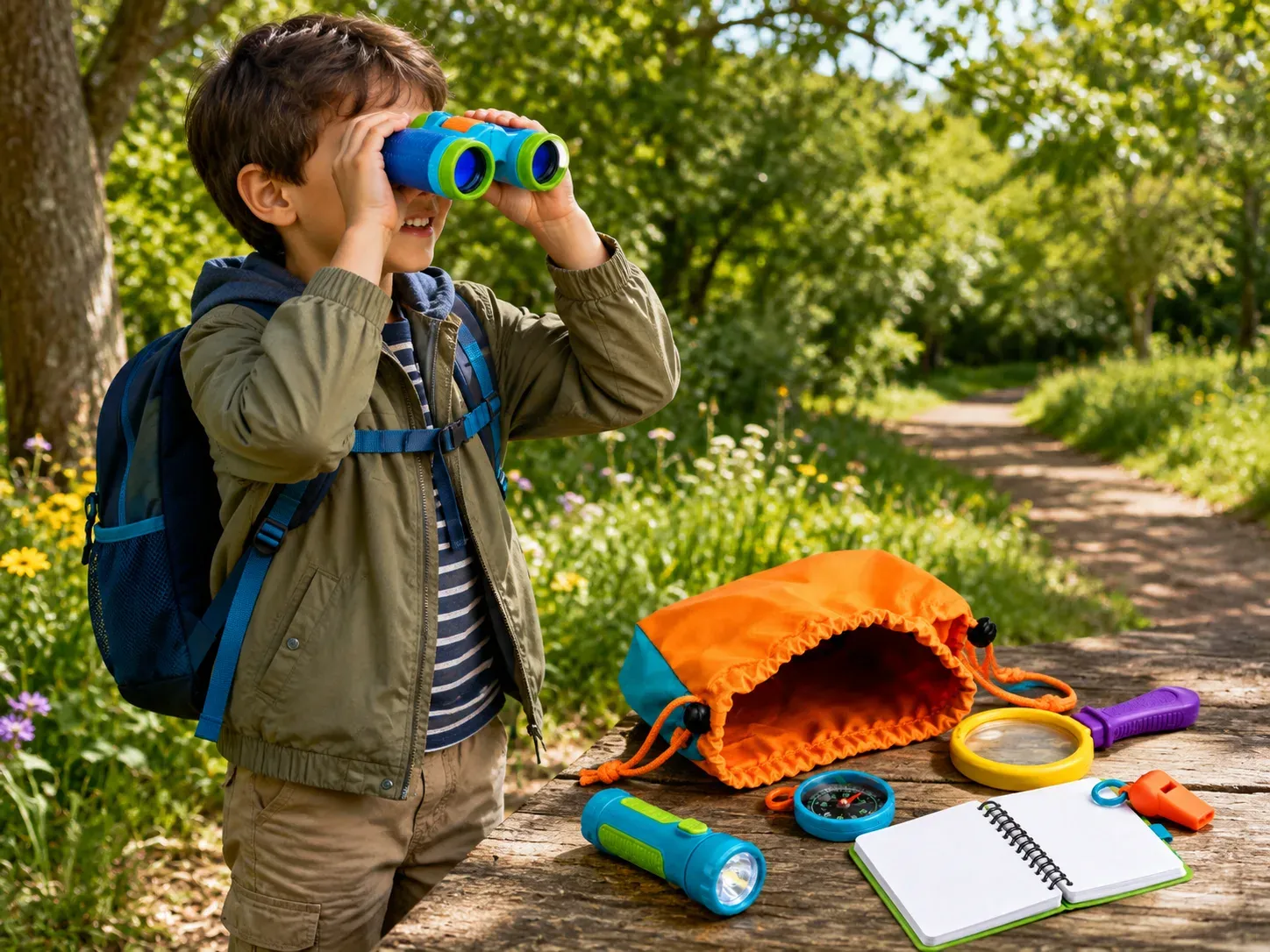
A walk around the neighborhood can look completely different once a child decides there is something worth investigating.
The same tree passed every afternoon suddenly has rough bark, tiny holes, patches of moss, and several kinds of leaves underneath it. A puddle becomes a place to compare reflections. A line of ants raises questions about where they are going. A bird that usually disappears into the background becomes something to follow with the eyes from branch to branch.
An outdoor explorer kit can help create that shift in attention.
The kit itself does not make a child curious. What it can do is give curiosity somewhere to go.
Binoculars make distant details easier to notice. A magnifier invites a closer look at textures and patterns. A flashlight can make a shaded corner, an evening walk, or a campsite feel different. A small notebook or collection pouch can give children a way to remember what they noticed.
The most useful outdoor kits are not those with the most accessories. They are the ones that encourage children to slow down, look carefully, ask questions, and return to the same places with fresh attention.
Exploration begins with noticing, not knowing
Adults sometimes feel pressure to answer every question a child asks outdoors.
“What bird is that?”
“Why is this leaf red?”
“What made this hole?”
It can be tempting to turn a walk into a rapid series of explanations.
But children do not need a complete science lesson every time they notice something.
Sometimes the best response is another observation.
“What do you notice about its beak?”
“Are all the leaves on this tree the same color?”
“Do you see any tracks near the hole?”
This keeps the child involved in the process rather than making the adult the source of every answer.
Scientific thinking at this stage can be very simple: look, compare, wonder, predict, and look again.
An explorer kit works best when it supports those habits instead of making children feel they need to identify everything correctly.
A familiar park becomes more interesting when the task changes
Children can become bored with places that adults consider perfectly pleasant.
The same park, path, or garden may feel repetitive after many visits.
Changing the purpose of the outing can change the experience.
Instead of “We are going for a walk,” the invitation might be:
“Let’s see how many different leaf shapes we can find.”
“Can we spot three birds without getting too close?”
“Let’s look for things that are rough, smooth, soft, and bumpy.”
“Can we find a place where insects seem especially busy?”
The environment has not changed.
Attention has.
A simple tool can reinforce that shift. Binoculars encourage looking upward or farther away. A magnifier brings attention downward toward bark, soil, stones, and fallen leaves.
Children begin to discover that the same place can offer different questions on different days.
Binoculars teach children to look before moving closer
When children notice an animal, their first instinct may be to approach it.
Binoculars introduce another option: stay where you are and observe from a distance.
That makes them especially useful for birds, squirrels, butterflies, or other wildlife that may disappear when people come too close.
Using binoculars also takes practice.
Children need to learn how to hold them steady, adjust their position, find an object with their eyes first, and then bring the binoculars into place.
At first, they may see nothing but sky or leaves.
That is normal.
Adults can help by choosing a large, stationary target first—a sign, a building, or a large tree branch—before trying to follow a moving bird.
The goal is not perfect technique.
The goal is helping children discover that some things are easier to understand when we observe without immediately touching or approaching.
A magnifier changes the scale of an ordinary object
Magnifiers are useful because they make small details feel important.
A leaf already looks familiar.
Under magnification, children may notice veins, tiny spots, torn edges, or small particles resting on the surface.
A stone may reveal layers or crystals.
Tree bark becomes a landscape of ridges and cracks.
Children often enjoy comparing the same object with and without the lens.
“What can you see now that you couldn’t see before?”
Questions like this make magnification feel less like a trick and more like a way of changing perspective.
The magnifier does not need to be used only for insects.
In fact, starting with non-living materials such as leaves that have already fallen, stones, seed pods, bark fragments, or soil can make exploration easier and calmer.
Looking closely does not mean collecting everything
Outdoor exploration can quickly turn into pockets full of leaves, sticks, rocks, flowers, and mysterious objects.
Collecting can be enjoyable, but it does not need to be the default.
Children can learn that observation and ownership are different things.
Some things can be looked at and left where they are.
A flower can be admired without being picked.
A snail can be watched without being carried home.
A spiderweb can be examined from a respectful distance without being touched.
If collecting is appropriate in a particular place, families can focus on loose, fallen materials such as leaves, seed pods, or small sticks rather than removing living plants.
Local parks and nature areas may have their own rules, so follow posted guidance.
This simple habit helps children understand that exploration includes restraint.
Respect for living things can be taught through small actions
Environmental care does not need to begin with big speeches about protecting the planet.
It can begin with the way a child handles one small encounter.
Walk around an ant trail instead of stepping through it.
Watch a butterfly without chasing it until it cannot rest.
Return a turned-over rock carefully if an adult has decided it is appropriate to look underneath.
Leave nests, eggs, and young animals alone.
Do not feed wildlife unless a place specifically permits it.
These actions communicate that nature is not only there for us to use.
Children can be curious and careful at the same time.
An explorer kit becomes more meaningful when it supports that attitude rather than encouraging children to capture, collect, or disturb every interesting thing they find.
The best questions are often the ones adults cannot answer immediately
A child may ask why one side of a tree has more moss.
Why some ants are larger than others.
Why one puddle dries faster.
Why one feather has a different pattern.
Adults do not need to pretend to know.
“I don’t know. What do you think?”
That response can be surprisingly useful.
It tells children that not knowing is allowed.
The next step might be to look again, compare another example, take a photo, make a note, or search for the answer later with a reliable source.
Curiosity becomes a process rather than a quiz.
Children learn that questions can remain open for a while.
Comparison turns observation into a deeper activity
Finding one interesting leaf is fun.
Finding two very different leaves creates a new question.
Which one is larger?
Which feels thicker?
Which has smoother edges?
Are the veins arranged the same way?
Comparison is one of the easiest ways to extend outdoor exploration without adding complicated equipment.
Children can compare:
- two kinds of bark,
- wet and dry soil,
- stones from different parts of a path,
- leaves from sun and shade,
- bird calls heard in two locations,
- shadows at different times of day,
- flowers of different shapes,
- tracks or marks in soft ground.
The adult does not have to explain the scientific reason immediately.
Simply helping the child notice differences is already valuable.
A notebook can turn a walk into a record of discovery
Not every explorer kit includes a notebook, but a small one can be one of the most flexible additions.
Children do not need to write complete sentences.
They can draw.
Make tally marks.
Circle colors.
Ask an adult to write down a question.
Create a simple map.
Tape in a fallen leaf if collecting it is permitted and appropriate.
Older children may enjoy writing dates or locations.
Younger children may simply make marks that represent what they remember.
The notebook gives the walk a memory.
When children return to the same place later, they can compare.
“Last time we saw three snails here.”
“This tree had fewer yellow leaves.”
“The puddle used to reach that rock.”
Observation becomes something that can continue over time.
Photography can support exploration without replacing it
Families often carry a phone outdoors anyway.
Used intentionally, the camera can support observation.
A child can photograph something that should not be collected.
Take the same picture from the same place on different days.
Zoom in later on a detail that was difficult to see.
Compare flower shapes or cloud patterns.
The important part is keeping the device in a supporting role.
If the child spends the entire walk looking through a screen, the exploration can become disconnected from the place itself.
Take the picture, then look again with the eyes.
The goal is not to produce a perfect gallery.
It is to preserve a clue or question for later.
Hand-crank flashlights add a different kind of investigation
A hand-crank flashlight can be appealing because the child does something physical before light appears.
It creates a clear relationship between action and result.
Depending on the product design, children may crank a handle, press a mechanism, or use another manual charging system.
That can lead to simple questions:
“What happens if you crank it longer?”
“How long does the light stay bright?”
“Does it feel different from a normal flashlight?”
There is no need to turn this into a formal lesson about energy.
The mechanism itself is enough to invite curiosity.
For outdoor use, flashlights can also make late-afternoon walks, camping, or shaded areas feel adventurous.
Children should still use them with normal safety boundaries: avoid shining bright light into people’s or animals’ eyes, and use them in places where adults can supervise movement.
Darkness changes the environment, so supervision matters more
Exploration after sunset can feel exciting because familiar places look different.
Sounds become more noticeable.
Shadows change.
Some animals become more active.
But low light also changes safety conditions.
Paths are harder to see. Uneven ground is easier to miss. Children can become excited and move faster than they realize.
Night exploration should therefore be simpler than daytime exploration.
Use familiar locations.
Stay close together.
Choose clear paths.
Make sure an adult controls the overall route.
The flashlight is a tool for seeing, not a reason to enter unknown spaces, holes, abandoned structures, or areas where footing is uncertain.
Adventure is more enjoyable when the boundaries are clear.
Outdoor exploration naturally involves movement
Children rarely investigate nature from one fixed posture.
They crouch to look at a beetle.
Stand on tiptoe to see a branch.
Walk around a tree.
Step across roots.
Carry a notebook.
Stop, start, turn, and change direction.
This makes nature exploration different from many tabletop activities.
The movement is not always the main goal, but it becomes part of the experience.
Adults can support this by choosing locations that match the child’s ability and by not rushing the route.
A short distance with many stops can be more engaging than a long walk that leaves no time to look.
Slow walks can be more successful than ambitious adventures
Families sometimes imagine outdoor exploration as a large trip: hiking, camping, or visiting a nature reserve.
Those can be wonderful experiences, but they are not required.
A child can investigate the edge of a sidewalk.
A small garden.
A patch of grass near an apartment.
A tree-lined street.
A school courtyard.
The quality of exploration depends less on distance and more on attention.
A ten-minute walk where a child notices five things may feel more meaningful than an hour-long outing where everyone is focused on reaching the destination.
This makes explorer kits practical even for families without easy access to large natural areas.
Weather gives children another variable to notice
The same location changes with weather.
After rain, soil darkens and puddles appear.
On a windy day, leaves move differently.
On a hot afternoon, some areas feel much warmer than shaded places.
After several dry days, grass may look different.
These changes can become part of the exploration.
“What is different from last time?”
Children do not need instruments to notice.
If the kit includes a simple weather-related tool, use it according to the product instructions and the child’s age.
Otherwise, observation alone is enough.
Weather also determines practical boundaries.
Dress appropriately, use sun or rain protection as needed, and postpone outings when conditions are unsafe.
Outdoor kits should be light enough for children to manage
A kit that is too heavy quickly becomes an adult’s bag.
For younger children, fewer tools are often better.
Binoculars.
A magnifier.
A notebook.
Maybe a flashlight when relevant.
That can be enough.
Children are more likely to feel ownership when they can carry, retrieve, and put away their own tools.
A small pouch with clear compartments can help, but the bag should not become so full that the tools are difficult to find.
If the child spends more time managing equipment than looking at nature, the kit is doing too much.
Durability matters because outdoor tools will be dropped
Explorer tools should be selected with real outdoor use in mind.
Children may drop binoculars on a path, place a magnifier on rough ground, or stuff a notebook into a bag quickly.
Look for products designed for the intended age group, with construction that can handle ordinary use.
Follow the manufacturer’s guidance for lenses, straps, batteries or charging mechanisms, and cleaning.
Check tools periodically for cracks, sharp damage, loose parts, or straps that have changed condition.
A good kit does not need to be indestructible.
It needs to be dependable enough that adults do not have to interrupt every few minutes with “Be careful with that.”
Fit matters for binoculars and straps
Children need tools that fit their bodies.
Binoculars that are too wide, too heavy, or difficult to focus can become frustrating.
Neck straps and carrying straps also deserve attention.
Use only the strap configuration recommended for the child’s age and the product design.
For younger children, adult supervision is especially important around cords and straps.
Do not add improvised long cords to outdoor tools.
A tool that fits well is easier to use and easier to manage safely.
Magnifiers require a few simple boundaries
Magnifying lenses are enjoyable, but children should know a few rules.
Use them for observation, not for focusing sunlight.
Do not aim concentrated sunlight at skin, plants, dry leaves, paper, or other materials.
Do not leave a magnifier positioned where direct sun can pass through it onto a surface.
Adults should supervise younger children.
These boundaries are simple and do not need to make the activity feel dangerous.
They simply keep the tool in its intended role: helping children see small details more clearly.
The kit should support curiosity, not turn every outing into a mission
Once families buy an explorer kit, it can be tempting to create a structured challenge every time.
Find ten leaves.
Spot five birds.
Complete the worksheet.
Fill the notebook.
That can be fun occasionally.
But not every walk needs a goal.
Children should still have time to wander, notice something unexpected, or ignore the tools entirely.
The kit is an invitation.
Not homework.
Some days the binoculars may stay in the bag because the child is more interested in jumping over cracks in the path.
That is still outdoor play.
Follow the child’s question when possible
Adults often arrive with a plan.
“We are going to look for birds.”
Then the child becomes fascinated by a puddle.
This is a useful moment to choose curiosity over the plan.
What is floating?
Why do some objects sink?
What can be seen in the reflection?
Are there tiny insects near the edge?
The bird activity can happen another day.
Following the child’s attention makes the investigation feel genuinely theirs.
It also reminds adults that exploration is not only about completing planned educational content.
Revisit the same place
Children do not always need new destinations.
Returning to the same place can deepen observation.
A familiar tree changes across seasons.
A path looks different after rain.
A garden changes as flowers bloom and fade.
Bird activity varies.
Shadows move.
When children already know the general environment, they can notice smaller differences.
Repetition gives them a baseline.
“This wasn’t here last time.”
“That branch used to have leaves.”
“We saw the same bird near this fence before.”
Familiarity creates room for comparison.
Create simple rituals around the explorer kit
A small routine can make the kit easier to use.
Before leaving, the child checks whether the magnifier, binoculars, and notebook are in the pouch.
After returning, tools go back to the same place.
Dirty or damp items are cleaned and dried according to their care instructions before storage.
The notebook stays with the kit.
These routines reduce missing pieces and make the next outing easier.
They also give children a small role in caring for their equipment.
The goal is not perfect organization.
It is simply making the explorer kit ready to use again.
Exploration can continue indoors after the walk
Outdoor discovery does not have to end at the door.
Children may want to draw what they saw.
Look up the name of a bird with an adult.
Compare photos.
Build the place with blocks.
Create a pretend field station.
Sort a small collection of permitted fallen materials.
Tell a story about an animal they watched.
This connection between outdoor experience and indoor play can extend an idea without requiring another purchase.
One walk can feed drawing, storytelling, building, and conversation for the rest of the day.
Parents do not need to be nature experts
Some adults hesitate to lead nature play because they cannot identify birds, insects, rocks, or plants.
Expert knowledge is not required.
You can say:
“I don’t know what that is.”
“Let’s look carefully.”
“What does it remind you of?”
“Maybe we can find out later.”
Children benefit from seeing adults wonder too.
The role of the adult is often to keep the outing safe, notice what the child is interested in, and help them look more closely.
Knowledge can come afterward.
Curiosity can happen immediately.
An explorer kit is only useful if the child wants to use it
Not every child will love binoculars.
Some may prefer collecting colors in a notebook.
Others may want to walk, climb, or invent stories outdoors instead of examining leaves closely.
That does not mean they are missing the point of nature play.
The kit should adapt to the child, not the other way around.
Offer tools without insisting.
Keep only the pieces that genuinely support the way the child likes to explore.
A simple pouch with one favorite magnifier can be more useful than a large kit whose contents are mostly ignored.
Choosing an outdoor explorer kit
When comparing kits, focus on usability rather than the number of accessories.
Consider:
- whether the tools are appropriate for the child’s age,
- whether binoculars are light enough to hold comfortably,
- whether lenses and handles are easy to grip,
- whether straps and cords are designed safely for the intended user,
- whether small components are appropriate for the age group,
- whether the flashlight or other mechanisms can be operated without excessive force,
- whether the storage bag is easy for the child to open and carry,
- whether the materials can be cleaned after normal outdoor use,
- whether individual tools still work well even if one accessory is lost.
Clear product instructions and age guidance are more useful than impressive accessory counts.
The most valuable tool may be attention
Explorer kits can be exciting because they make children feel prepared for an adventure.
But the real skill being practiced is not owning binoculars or carrying a magnifier.
It is attention.
Looking long enough to notice that two leaves are different.
Staying far enough away to watch an animal continue its behavior.
Returning to the same tree and seeing that something changed.
Asking a question without needing the answer immediately.
Remembering what happened last time.
Tools support these habits. They do not replace them. Read more about balance bikes for outdoor toddler mobility, explore simple STEM play ideas, and check our guide on 10 things to check before choosing educational toys.
Recommended Serious Fun Outdoor Products
Equip young explorers with Serious Fun’s outdoor gear:
- Outdoor Explorer Kit: Complete nature adventure kit featuring easy-focus binoculars, real magnifying glass, hand-crank flashlight, and canvas field bag.
- Mini Balance Bike: Lightweight toddler balance bike for active outdoor mobility and physical confidence.
Conclusion
An outdoor explorer kit can turn an ordinary walk into a richer experience because it gives children simple ways to change how they look at familiar places.
Binoculars encourage observation from a distance.
Magnifiers make small textures and patterns easier to notice.
Flashlights add another way to explore light and familiar environments.
Notebooks and photographs can help children remember questions and compare what they see over time.
The value of the kit does not come from turning every outing into a science lesson.
It comes from giving children time to notice, wonder, compare, and return.
Adults can support that process by following the child’s questions, setting clear safety boundaries, respecting living things, and being comfortable saying, “I don’t know—let’s look.”
That is often enough.
A child does not need a large expedition to begin exploring.
Sometimes all it takes is a familiar path, one simple tool, and permission to stop when something small becomes interesting.
