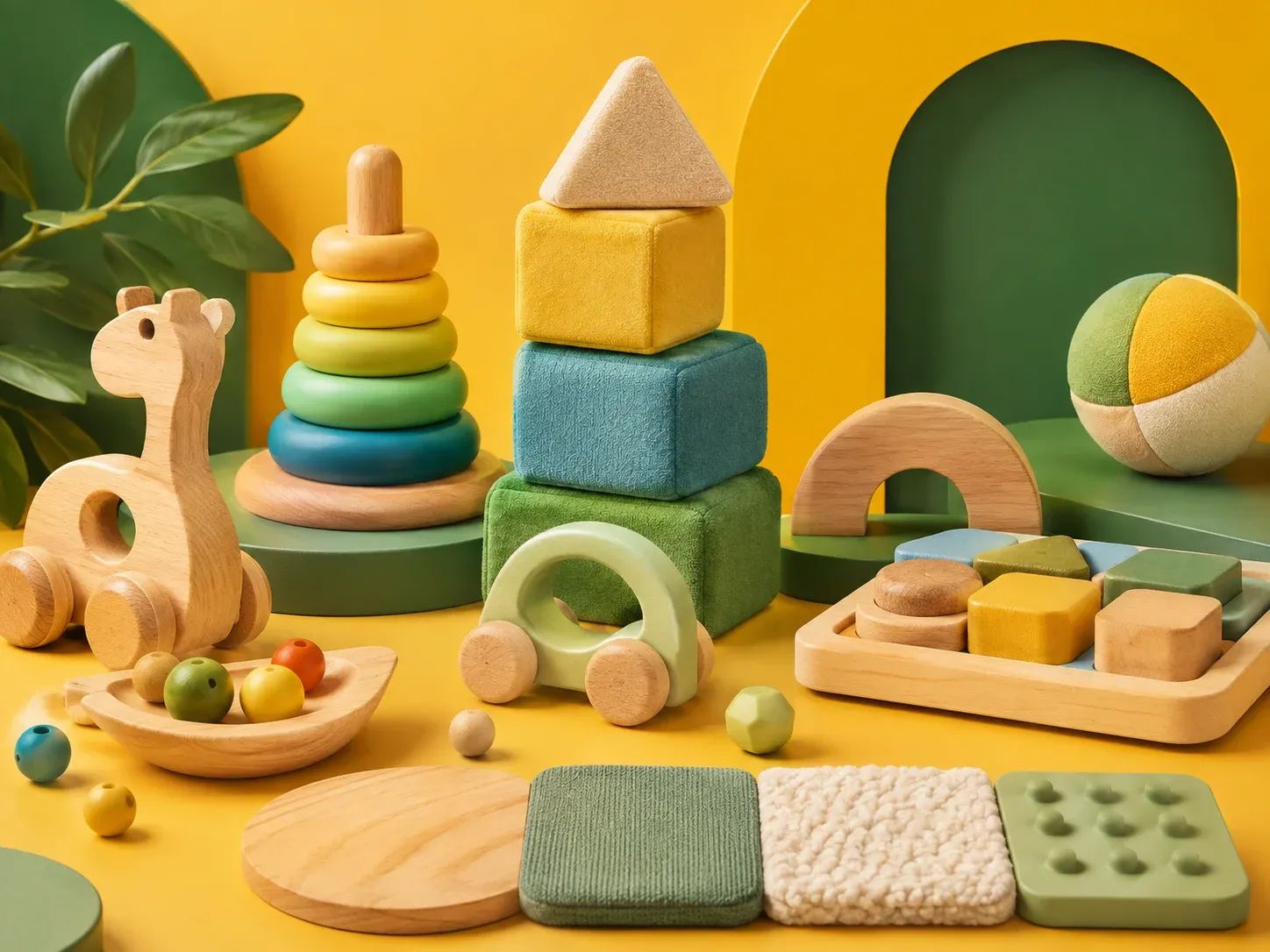
Children’s toys rarely stay in one place. A block that begins the morning on a shelf may spend the afternoon on the floor, travel into a pretend kitchen, disappear under the sofa, and end the day inside a storage basket. A favorite figure may go from small hands to a backpack, a friend’s house, the garden, and back again.
That is simply what toys are made for: being handled, moved, shared, dropped, carried, and used again.
Because of that, toy care does not need to be about keeping everything looking brand new. A more useful goal is to keep toys comfortable to use, reasonably clean, easy to inspect, and in good enough condition to support the next round of play.
The routine can be simple. What matters is knowing that different materials need different treatment, moisture should not be trapped where it does not belong, and cleaning is also a useful opportunity to notice wear before a small problem becomes a larger one.

Start with how the toy is actually used
Before deciding how often a toy needs cleaning, look at its role in daily life.
A wooden block set that stays in a quiet bedroom does not have the same routine as play food used by several children in a classroom. A stuffed animal that sleeps beside a child every night will need different care from a puzzle that comes out once a week.
Frequency of use matters, but so does where the toy goes.
Toys may need more attention when they are:
- frequently shared between children,
- used around food,
- carried outdoors and brought back inside,
- handled by younger children who often put objects near their mouths,
- stored in humid or dusty areas,
- used in schools, waiting rooms, playgroups, or other shared spaces.
This does not mean every toy needs to be thoroughly cleaned after every play session.
In many homes, a light, regular routine is easier to maintain and more appropriate than turning toy care into a constant deep-cleaning project. Visible dirt can be handled when it appears, high-use items can be checked more often, and less-used materials can be cleaned as part of a broader reset.
The goal is consistency, not perfection.
Read the material before reaching for water
One of the easiest ways to damage a toy during cleaning is to treat every material the same.
Wood, plastic, fabric, paper, metal, foam, and electronic components respond differently to moisture, friction, heat, and cleaning products. A method that works perfectly for a washable plastic toy may be unsuitable for an unfinished wooden piece or an electronic sound toy.
Start with the manufacturer’s care instructions when they are available.
Then look at the toy itself. Does the surface absorb water? Is it painted, coated, printed, or laminated? Are there seams or openings where liquid could collect? Can batteries or electronic parts be removed? Is a fabric piece machine washable, hand washable, or spot-clean only?
These details help determine the gentlest method that will do the job.
Toy care tends to work better when cleaning is matched to the material rather than based on one universal routine.
Everyday cleaning does not need to be aggressive
For many toys, especially those used at home, routine care can be surprisingly simple.
A clean, soft cloth that is lightly dampened may be enough to remove dust, fingerprints, or minor surface dirt from many non-electronic, non-porous surfaces. The key word is lightly. The cloth should clean the surface without leaving the toy saturated.
If a toy needs more than water, use a mild cleaning method that is appropriate for the material and follows the product’s care instructions.
Stronger is not automatically better.
Harsh products, abrasive scrubbing, excessive soaking, or very hot water can affect finishes, printed details, adhesives, fabric fibers, or moving parts. Strong fragrances can also remain on objects children handle closely.
When a toy only has a small mark, clean the mark rather than treating the entire item as if it needs a full wash.
A small, repeatable routine is usually easier on both the toy and the person doing the cleaning.
Wooden toys usually prefer less water
Wood is one of the clearest examples of why material-specific care matters.
Depending on how a wooden toy is made and finished, too much moisture can affect its surface or encourage swelling, warping, or changes around joins. That is why soaking a wooden toy is generally not a good default unless the manufacturer specifically says the product is designed for it.
For ordinary surface cleaning, use a soft cloth that is damp rather than wet.
Wipe the toy, paying attention to areas that are handled frequently, then let it dry completely in a well-ventilated place before putting it back into a closed container.
Avoid leaving wooden toys sitting in water or storing them while they still feel damp.
Also take the opportunity to run your hand over the surface. A small change in texture, a developing crack, or a rough edge may be easier to notice while cleaning than during a busy play session.
Wooden toys do not have to remain visually perfect. Small signs of ordinary use are different from damage that affects comfort or safety.
Plastic toys can be easy to clean, but check the construction
Plastic is often straightforward to wipe, but “plastic toy” covers a wide range of products.
A solid molded piece has different cleaning needs from a toy with stickers, trapped air spaces, metal axles, batteries, sound modules, or openings where water can enter.
Before rinsing or immersing anything, check whether liquid could reach an area that will be difficult to dry.
Hollow toys deserve particular attention. If water enters through a small opening and cannot easily escape, moisture may remain inside even when the outside looks dry.
For toys with multiple parts, separating components before cleaning can make the process easier. It also gives you a chance to check whether pieces still fit correctly and whether any part has become cracked, distorted, or unusually loose.
After cleaning, leave pieces apart until they are fully dry.
Fabric toys need care that matches their filling and construction
Soft toys collect a different kind of wear.
They may gather dust, lint, food marks, and the general signs of being hugged, carried, dragged, and slept beside. Some are designed for machine washing, while others contain filling, sound units, glued decorations, delicate stitching, or other parts that require gentler treatment.
Check the care label first.
If machine washing is allowed, follow the listed temperature, cycle, and drying guidance rather than assuming every plush toy can be treated the same way.
If the item is spot-clean only, focus on the affected area and avoid soaking the entire toy unnecessarily.
Drying matters just as much as washing. Thick fabric or filling can feel dry on the outside while still holding moisture inside.
Give soft toys enough time and airflow to dry completely before returning them to beds, baskets, or enclosed storage.
This is especially important for frequently cuddled items because children may hold them close to their face for long periods.
Electronic toys need a different routine
Electronic toys should not be cleaned like ordinary washable toys.
Water and battery compartments are not a useful combination.
Before cleaning, switch the toy off. If the manufacturer’s instructions recommend removing batteries before care or storage, follow that guidance.
Use a method designed for the exterior surface and avoid allowing liquid to enter buttons, speakers, charging ports, seams, or battery compartments.
Do not spray liquid directly onto the toy.
Instead, apply the appropriate cleaning method to a cloth when the product instructions allow it, then wipe the exterior carefully.
Cleaning is also a good time to check the battery area for damage, unusual residue, or parts that no longer close securely. If something appears wrong, stop regular use and follow the manufacturer’s guidance.
Electronic features can make a toy engaging, but they also create parts that need to remain dry and intact.
Paper, cardboard, and puzzle pieces often need prevention more than washing
Not every play material can or should be wet-cleaned.
Board books, cardboard puzzles, cards, and paper-based materials usually benefit more from dry storage and quick attention to spills than from routine washing.
Wipe small marks only when the surface is designed to tolerate it, and avoid soaking edges where layers may separate.
For these materials, prevention does much of the work.
Keep drinks away from the storage area when practical. Make sure hands are reasonably clean before a long card or puzzle session. Store pieces flat or in a container that prevents bending and crushing.
If one piece becomes damaged, check whether the toy is still comfortably usable.
A slightly worn puzzle edge may be cosmetic. A piece that has split into sharp layers or a card that is deteriorating into small fragments may need different attention.
The same principle applies throughout toy care: judge condition by function and safety, not by whether an item still looks new.
Drying is part of cleaning, not an afterthought
It is easy to think the job is finished once visible dirt is gone.
But a toy that is cleaned and then immediately sealed inside a box while still damp has not really completed the care cycle.
Moisture can collect between stacked pieces, inside fabric folds, around joins, or at the bottom of storage containers.
After cleaning, spread toys out when possible.
Separate pieces. Open lids. Leave fabric items with enough airflow. Put wooden toys on a dry surface rather than stacking them immediately. Follow manufacturer guidance for any item with special drying requirements.
There is no need to rush the process simply because the shelf looks unfinished for a while.
A toy that dries properly is far easier to store with confidence.
Cleaning is the perfect time for a quick condition check
A useful care routine does two jobs at once: it cleans and it inspects.
When you already have a toy in your hand, take a few seconds to notice whether anything has changed.
Look for:
- loose or newly moving parts,
- cracks or splits,
- sharp or rough areas,
- damaged cords or fabric seams,
- peeling components,
- wheels or joins that no longer sit correctly,
- battery covers that do not close securely,
- pieces that have broken into a smaller size,
- unusual changes in shape after heat or wear.
Not every mark is a reason to discard a toy.
A scratch on a block is different from a crack that creates a sharp edge. Faded color is different from a coating that is actively peeling. A dented storage box is different from a damaged structural part.
The question is whether the change affects how safely and comfortably the toy can still be used.
Know when a toy should leave regular play
There is a point where “well loved” becomes “no longer suitable for normal use.”
If a toy has a structural problem, sharp damage, exposed internal parts, unstable components, or another issue that could create a hazard, remove it from regular play while you decide what to do next.
For repairable items, follow the manufacturer’s guidance when available.
Avoid improvised repairs on critical parts if the repair could introduce a new risk. A quick fix that looks strong enough may not behave like the original construction under repeated play.
Some toys can be repaired appropriately. Others are better retired.
It can be disappointing to remove a favorite, but keeping an object in circulation simply because a child loves it is not always the right choice once its condition has significantly changed.
Missing pieces deserve a closer look
A missing part is not always a problem.
A block set can still be useful with one fewer block. A group of animal figures does not stop supporting pretend play because one figure disappeared under unknown circumstances.
But some toys depend on specific pieces to function correctly.
If a component is missing, ask whether the remaining toy still works as intended and whether the missing part has changed the size, stability, or construction of anything that remains.
Also think about where the missing piece might be.
In a home with younger siblings, a detached small component matters differently than it might in a household with older children.
Keeping sets broadly organized makes this easier to notice without requiring families to count every piece after every play session.
Shared toys need a more deliberate routine
Toys in classrooms, playgroups, clinics, waiting rooms, libraries, or shared family spaces are handled by more people than toys used by one child at home.
That usually means care needs to be more structured.
The exact routine depends on the setting, material, manufacturer instructions, and any relevant institutional or local hygiene guidance.
A practical system can include:
- separating items that need cleaning from ready-to-use materials,
- choosing toys whose surfaces can realistically be maintained,
- allowing enough drying time before items return to storage,
- checking high-use pieces more frequently,
- making sure staff or caregivers know which materials cannot be soaked,
- removing damaged toys promptly instead of returning them to a shared shelf.
If disinfection is required in a particular setting, follow the toy manufacturer’s instructions and the applicable guidance for that environment. Do not mix cleaning chemicals, and do not assume that a method suitable for one material is suitable for another.
The best shared-toy routine is one people can follow consistently.
Illness may change the routine temporarily
Most everyday toy care does not need to feel like emergency cleaning.
There are, however, times when a household or group setting may choose to clean certain high-contact items more deliberately, such as during or after illness.
In those situations, prioritize toys that were actually handled and follow appropriate product-care instructions.
Washable and non-washable materials may need different treatment. Soft comfort items, shared play food, frequently mouthed toys, and electronic toys should not all be handled with one cleaning method.
If a toy cannot be cleaned in a way that is compatible with its material, temporarily setting it aside may be more practical than damaging it with an unsuitable process.
After the higher-attention period passes, families can return to a normal maintenance rhythm.
Storage determines how quickly toys become messy again
Cleaning a toy and returning it to a dusty, damp, overcrowded container defeats part of the purpose.
Storage should protect the toy while still making play easy.
That does not require a complicated organizing system.
Broad categories usually work well: blocks together, pretend-play pieces together, puzzles in one area, art materials in another. Children are more likely to help with clean-up when the destination is obvious.
Avoid containers that are so tightly packed that toys are constantly crushed, bent, or forced into place.
For sets with many components, choose a container that makes it easy to see whether major pieces are present.
Open baskets can work well for frequently used items. Closed boxes can help protect materials that collect dust. The right choice depends on the toy and the room.
Most importantly, only put toys into enclosed storage once they are dry.
Clean storage containers too
Toy care often focuses on the toy while ignoring the box, basket, shelf, or tray that holds it.
Those surfaces collect their own dust and dirt.
Every so often, empty the container completely and clean it using a method appropriate for its material. Let it dry before replacing the contents.
This is also a useful moment to remove unrelated objects, bits of paper, broken crayons, food crumbs, or small pieces that have migrated from other sets.
A cleaner container makes the next routine easier and helps prevent freshly cleaned toys from immediately returning to a dirty environment.
It can also reveal whether the storage system still makes sense.
If every basket is overflowing, the issue may not be cleaning at all. The family may simply need a better rotation or a clearer place for certain materials.
Outdoor toys need their own expectations
Outdoor play materials experience weather, dirt, moisture, and rougher surfaces than indoor toys.
Do not expect them to remain cosmetically perfect.
Instead, focus on whether they are appropriate for outdoor use and whether their construction still works as intended.
Remove loose dirt before bringing indoor-outdoor toys back into the house. Let wet items dry rather than sealing them immediately in storage.
Check wheels, handles, joins, and surfaces that regularly contact pavement or soil.
For products designed to remain outside, follow the manufacturer’s guidance on exposure, storage, and maintenance.
An indoor toy that happens to survive one afternoon outside is not necessarily designed for repeated sun, rain, or temperature changes.
Using products within their intended environment is one of the simplest ways to support their lifespan.
Do not over-clean toys into early retirement
It is possible to damage a toy by caring for it too aggressively.
Repeated soaking, strong products, abrasive scrubbing, unnecessary high heat, or frequent machine washing can shorten the life of materials that did not need that level of treatment.
That is why visible condition and usage context matter.
A toy with a little dust needs dust removed. A washable item with a significant mess may need a fuller wash. A shared item in a setting with specific hygiene requirements may need another process entirely.
Match the response to the situation.
More cleaning is not automatically better care.
Good care is the least aggressive method that appropriately addresses the actual need while respecting the material.
Let children participate in simple care
Toy care can gradually become part of a child’s normal play routine.
Young children can place blocks back in a basket, bring washable pieces to a cleaning area, match puzzle pieces to their boxes, or help spread items out to dry.
Older children can learn to notice when something is damaged or when a favorite material needs attention.
The purpose is not to turn playtime into a list of chores.
It is to help children understand that the objects they use can be cared for, reset, and made ready for another day.
Simple responsibilities also make maintenance less dependent on one adult doing a huge clean-up later.
A child who knows where toys belong is more likely to help protect complete sets and notice when something is missing.
A small routine is easier to maintain than a cleaning marathon
Toy care becomes exhausting when everything is postponed until the shelves feel out of control.
A lighter rhythm usually works better.
During everyday clean-up, deal with obvious spills and put pieces back where they belong. Every so often, wipe high-use items, wash fabrics according to their care instructions, and empty storage containers that need attention.
While doing that, inspect for wear.
There is no need to clean every single object on the same day.
Families can work by category, by room, or simply by what has been used most heavily.
Schools and shared spaces may need a more formal schedule, but the same principle still helps: the system should fit the actual workload.
A routine that people can sustain is more useful than an ambitious one that is abandoned after a week.
Care also protects the play experience
Cleaning and maintenance are often discussed only in terms of hygiene and lifespan, but they affect play itself.
A puzzle is less inviting when pieces are sticky or bent. A vehicle becomes frustrating when its wheel is jammed with debris. Blocks are harder to use when several pieces are buried in unrelated storage.
A well-cared-for toy works the way the child expects it to.
That reliability matters because children can stay focused on the idea they are exploring instead of dealing with a product that no longer behaves properly.
Maintenance therefore supports more than the object.
It supports continuity in play.
Toys do not have to look new to be worth keeping
A good toy can show signs of use and still have years of play left.
Minor scuffs, softened fabric, small surface marks, or a faded storage box can simply be evidence of a toy doing its job.
Trying to preserve a child-facing object in showroom condition can create unnecessary stress for everyone.
A better standard is functional care.
Is it clean enough for the way it is used? Is it fully dry? Are the important parts secure? Is the surface still comfortable? Does the toy continue to work as intended?
If yes, ordinary signs of use do not need to be treated as failure.
Durability includes the ability to age gracefully.
A practical toy-care rhythm
For families who want a simple starting point, the routine can be kept very light.
After play, put pieces back into clear categories and deal with obvious messes.
When something needs cleaning, check the material first and use the gentlest appropriate method.
Let everything dry before closing containers.
While the toy is in your hand, give it a quick condition check.
The routine becomes more specific only when the toy, setting, or situation calls for it. To explore more about long-term maintenance, see our guide on durable toys, discover how to integrate cleaning with your toy rotation routine, and read our guide on choosing toys for schools.
Recommended Serious Fun Products
Serious Fun toys feature smooth, high-quality finishes designed for easy care and maintenance:
- Montessori Learning Board: Smooth birch plywood activity board with securely attached tactile modules that wipe clean easily.
- Pretend Play Kitchen Set: Food-contact-safe wooden cookware and mini stainless steel pans made for simple cleanup.
Conclusion
Toy care does not need to become another complicated household project.
Most of the work comes down to a few steady habits: understand the material, clean only as much as necessary, dry thoroughly, inspect while handling, and store toys in a way that makes them easy to use again.
Wood, plastic, fabric, electronics, paper materials, and outdoor toys each have different limits, so the best routine is one that respects how the product was made.
In shared environments, cleaning may need to be more deliberate. At home, a lighter rhythm may be entirely appropriate.
Either way, the purpose is not to keep children’s toys looking untouched.
It is to help the things they use every day remain clean enough, comfortable enough, complete enough, and dependable enough to return to play again and again.
