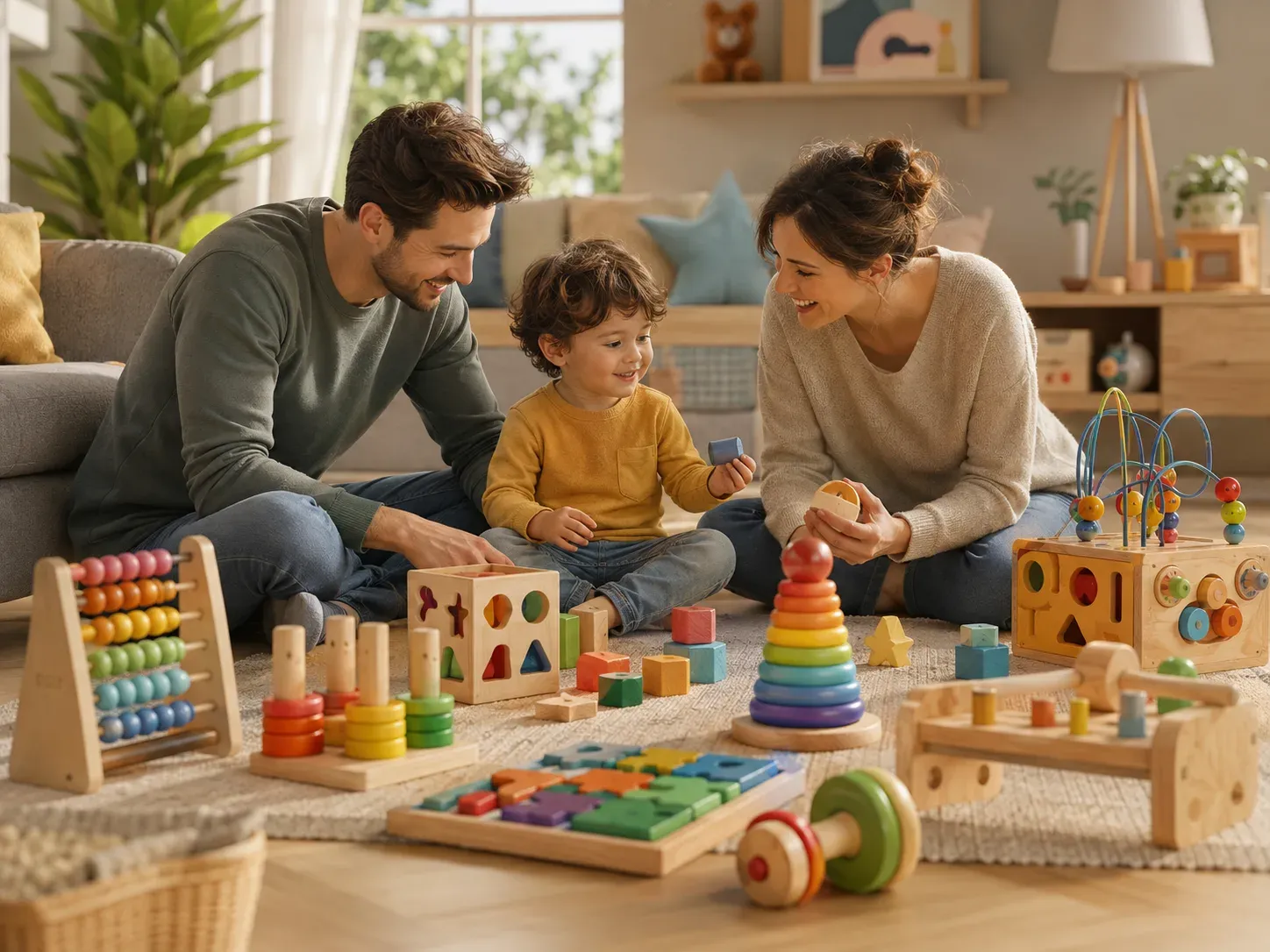
A calm play corner does not have to look like a miniature classroom or take over an entire room. In many homes, the most useful play spaces are much simpler: a rug beside a low shelf, a basket near the sofa, or a small section of a child’s bedroom where a few familiar materials are always within reach.
What matters is not how impressive the space looks. What matters is whether a child can understand it.
Can they see what is available? Can they reach it without asking an adult? Is there enough open floor space to begin building, drawing, pretending, or reading? And when they are finished, is it reasonably clear where things go back?
Those small design choices can make everyday play feel easier. Instead of waiting for an adult to set up an activity, children are more able to notice an idea, choose something, and begin on their own. For parents, that can also mean fewer moments spent searching for missing pieces, moving piles of toys, or repeatedly explaining where everything belongs.

The goal is not to create a perfectly tidy children’s room. A useful home play space should still look lived in. Blocks will end up on the floor, books will be opened in the wrong direction, and a pretend kitchen may suddenly become a veterinary clinic. The point is to give that activity a clear home so children can explore without the whole room feeling visually or physically chaotic.
Choose a visible but peaceful spot
Young children often want a little independence without feeling completely separated from the adults around them. That is why a play corner tucked into the edge of a living room, family room, kitchen area, or bedroom can work better than a beautiful playroom that feels too far away from everyday family life.
A useful spot lets children stay connected while still having enough space to settle into an activity. They may build with blocks while a parent folds laundry nearby, look through books while dinner is being prepared, or create a pretend shop beside the sofa while adults talk.
The location does not need to be silent. In fact, some children play more comfortably when ordinary household sounds are still happening around them. What helps is avoiding places with constant interruption: directly in a doorway, beside a frequently opened cabinet, or in a walkway where every project has to be moved after ten minutes.
Before setting anything up, watch how your family already uses the room. If everyone naturally gathers in one area, that may be a better location than choosing a corner simply because it is empty.
A play corner works best when it fits the rhythm of the home rather than fighting against it.
Use simple boundaries that children can understand
Children do not need walls to understand that a certain area is for play. Small visual cues are often enough.
A rug can define where blocks and figures belong. A low shelf can separate the play area from the rest of the room. A small table can become the place for puzzles, drawing, or clay. Even two baskets placed beside each other can signal that this section of the room has a specific purpose.
These boundaries are useful because they make the space easier to read. A child does not have to remember a long instruction such as, “Please keep all of your toys on this side of the room and do not spread them near the hallway.” The environment itself gives part of the message.
That does not mean play must stay perfectly inside the lines. A train track may stretch beyond the rug. A blanket fort may temporarily absorb half the living room. Flexible boundaries are usually more realistic than strict ones.
The goal is simply to create a recognizable home base. When children know where play starts, they are also more likely to understand where materials should return afterward.
Keep storage low, visible, and easy to use
Storage can either support independent play or quietly make it harder.
Deep toy boxes are convenient for quickly hiding clutter, but they often create a different problem: children cannot see what is inside. They may dump everything out while searching for one toy, forget about materials buried at the bottom, or ask an adult for help before they have even started playing.
Low shelves, shallow baskets, and open trays make choices more visible. A child can notice a puzzle, a set of blocks, or a basket of animal figures and decide what they want to do without needing someone else to prepare the activity.
The same idea applies to clean-up. If a four-year-old has to remember an elaborate organization system with twelve tiny categories, the setup is probably doing too much. Storage should be specific enough to make sense but simple enough for a child to use consistently.
For example, one basket for vehicles, one tray for puzzles, one shelf for books, and one container for blocks may be more practical than sorting every object by brand, material, or color.
Picture labels can also help younger children. A simple photo of blocks on the block basket or a small book icon on the reading shelf gives children a visual cue before they are able to read labels independently.
The best organization system is not the one that looks most impressive after adults tidy it. It is the one children can actually maintain with reasonable support.
Offer fewer toys, but make the choices worthwhile
A common instinct is to fill a play area so children will never run out of things to do. In practice, too many visible choices can make a space harder to enter.
When shelves are packed tightly and several baskets overflow at once, a child has to sort through a lot of visual information before deciding where to begin. Some children respond by pulling everything out. Others move quickly from one toy to another without staying with any activity for long.
A calmer play corner usually benefits from a smaller selection of materials, especially toys that can be used in more than one way.
Blocks can become towers, roads, houses, bridges, food, or furniture for small figures. Animal and people figures can support storytelling. Scarves can become capes, picnic blankets, rivers, or roofs. Simple pretend-play tools can support dozens of different scenarios. Books, puzzles, drawing materials, and construction toys add other kinds of challenge without requiring a large collection.
This does not mean the rest of the toys need to disappear permanently. Families can rotate materials instead.
Keeping some toys out of sight for a few weeks and bringing them back later can make familiar objects feel interesting again. Rotation also gives adults a chance to notice what a child is genuinely using rather than assuming every toy needs to remain available at all times.
A useful question is not, “How many toys can fit here?” It is, “What kind of play does this corner make easy to begin?”
Think about different kinds of play, not just different toys
When choosing what belongs in a home play space, it can help to think in terms of experiences rather than categories of products.
Does the corner allow a child to build something? Tell a story? Look closely at a book? Solve a small problem? Draw or make something? Pretend to care for a doll or cook a meal? Sit quietly for a few minutes?
A small collection can support all of those experiences without requiring a huge room.
For example, a shelf might hold one basket of blocks, a few small figures, several books, one puzzle, and a drawing tray. That is already enough material for construction, pretend play, language, problem-solving, and creative expression.
Thinking this way also helps prevent the play corner from becoming a display of disconnected toys. Each item has a reason to be there because it contributes to a kind of play the child can return to.
Make the space physically comfortable
Children spend a great deal of playtime close to the floor, so comfort matters more than adults sometimes expect.
A rug or foam mat can make sitting, kneeling, and building more pleasant. Good natural light or a nearby lamp helps with books, puzzles, and drawing. A small cushion can make a reading area more inviting. If a table is included, it should be low enough that the child can sit and work without constantly adjusting their body.
Comfort also includes access. Materials that children are allowed to use independently should be within their reach. Fragile decorations, adult electronics, or items that repeatedly require the child to ask permission can make the space frustrating.
When possible, arrange the corner from the child’s eye level rather than the adult’s. Sit on the floor for a moment and look around. Can the child clearly see the choices? Is anything important hidden behind something taller? Is there enough room to move a large block structure without bumping into furniture?
These are small details, but they affect whether the space feels genuinely usable.
Leave some open space instead of filling every surface
An empty patch of floor may look unfinished to an adult, but to a child it is possibility.
Children need room to spread out a puzzle, line up vehicles, build a tower, move figures through an imaginary landscape, or simply change position while playing. If every corner is occupied by furniture, bins, tables, and decorative storage, the play space can become visually organized but physically restrictive.
Try to protect a little open floor area. It does not need to be large. Even enough room for a child to sit comfortably with materials in front of them can make a significant difference.
Open space also makes transitions easier. A child can move from building to pretend play without first clearing an entire table. Siblings can join without immediately competing for the same small surface.
A calm play corner is often created as much by what you leave out as by what you add.
Leave room for unfinished play
Adults often think of clean-up as the natural ending of play, but children do not always experience their projects that way.
A block city built before lunch may still feel unfinished. A drawing may need another session. A group of animal figures may be in the middle of a story that the child wants to continue later.
If every activity must be completely dismantled the moment play stops, children lose the chance to return to an idea and develop it over time.
When space allows, create one small “save spot”: a tray, a low shelf, one corner of a table, or a section of the rug where an unfinished project can remain for a while.
This does not mean the entire room needs to stay untouched indefinitely. Families can create simple limits such as keeping one project overnight or choosing one structure to save while everything else is returned to storage.
That balance respects the child’s work while still keeping shared spaces functional.
It also sends a useful message: play is not always disposable. Sometimes an idea is worth coming back to.
Make clean-up part of the design, not a separate battle
If cleaning up the play corner regularly becomes a long argument, the problem may not be motivation alone. The environment itself may be asking too much.
Children are more likely to participate when they know where things go and the task feels manageable. “Put all the toys away” can feel enormous. “Blocks in this basket, books on this shelf, and animals in that tray” is much easier to understand.
It also helps when the quantity of available materials matches the child’s ability to reset the space. If twenty containers are emptied every afternoon, even a cooperative child may struggle to restore the room without substantial adult help.
Parents can support the process by cleaning alongside younger children rather than expecting complete independence immediately. Over time, the child begins to recognize the routine and take on more of it.
Simple phrases work better than repeated lectures: “Let’s put the blocks back so the floor is ready for tomorrow,” or “You do the books and I’ll collect the animals.”
The aim is not a spotless room. It is helping children understand that caring for the space is part of using it.
Adjust the corner as your child changes
A play corner that works beautifully at age two may feel completely different at four or five.
Toddlers may need sturdy objects, simple baskets, board books, stacking toys, and generous floor space. Preschoolers may become more interested in pretend play, puzzles, drawing, construction, and small-world scenes. Older children may want a table for making, a dedicated reading spot, or storage for projects that stay in progress for several days.
That is why it is useful to observe the space rather than treating the setup as permanent.
Notice what consistently stays untouched. Notice which materials migrate to another room because the child prefers playing there. Notice whether the shelf has become too crowded, whether the table is now too small, or whether a once-popular toy is taking up space without being used.
A few small changes can refresh the entire area. You might remove several toys, bring books lower, replace a baby puzzle with more challenging materials, or move the rug closer to where the family spends time.
The play corner should grow with the child rather than becoming a fixed display adults are reluctant to change.
Do not confuse calm with silent or perfectly tidy
A calm play space is not a space where children sit quietly and never make a mess.
Good play can be energetic. Children may talk loudly to themselves, crash block towers, spread fabric across the floor, or turn carefully organized objects into something completely different. That does not mean the environment has failed.
“Calm” is better understood as clarity. The child knows what the space is for. Materials are accessible. There is enough room to act on an idea. The number of choices is manageable. Cleaning up is possible. The environment supports play instead of constantly interrupting it.
A visually perfect children’s room can actually be difficult to use if children are afraid to disturb it. A more successful space is one that invites them to touch, move, build, rearrange, and return.
Start small and watch what happens
There is no need to redesign an entire room at once.
Start with one small area and a few materials. Put down a rug, choose two or three baskets, add several books, and leave some floor space open. Then watch how your child responds over the next several days.
Do they begin playing there without being prompted? Do they carry certain toys somewhere else? Do they ask for materials that are stored too high? Does the space stay usable, or does it become crowded almost immediately?
Those observations are more valuable than copying a perfectly styled playroom from a photograph. To keep your play space fresh without buying new items, try applying a thoughtful toy rotation routine. Focus-building tools like a Montessori activity board or versatile materials for open-ended play fit wonderfully into a calm nook.
Every home has different space limitations, routines, siblings, furniture, and noise levels. Every child also has different interests and ways of settling into play.
A play corner becomes useful through adjustment, not perfection.
Recommended Serious Fun Products
Create a calm, structured, and beautiful play space at home with these Serious Fun products:
- Montessori Learning Board: Integrated activity board designed to foster independent focus and practical life skills.
- Sensory Activity Cube: Multi-sided tactile activity cube perfect for peaceful, self-directed exploration.
Conclusion
A thoughtful play corner gives children something simple but important: a place where beginning to play feels easy.
It does not require a separate playroom, expensive furniture, or shelves full of educational toys. A visible location, a few understandable boundaries, accessible storage, open floor space, and a carefully chosen set of materials can already change how a child uses the room.
When the environment is easier to read, children can make more decisions for themselves. They can choose an activity, stay with an idea, return materials, and come back later without needing an adult to organize every step.
For families, the benefit is not perfect tidiness. It is a home that can hold both everyday life and children’s play without the two constantly competing with each other.
That is what makes a calm play corner useful: not that nothing gets messy, but that the space remains understandable, welcoming, and ready for the next idea.
