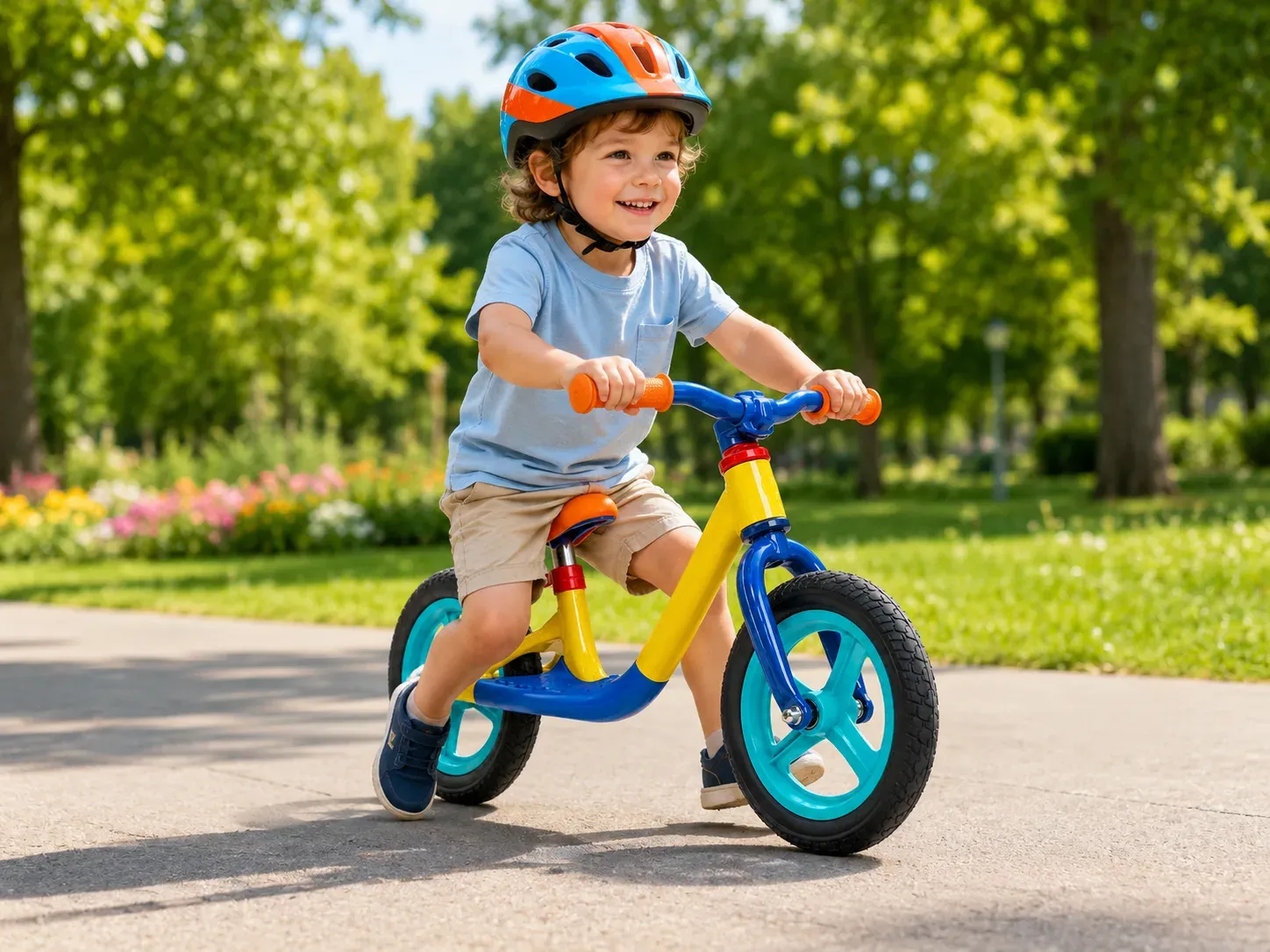
A toddler’s first experience on two wheels does not have to begin with pedaling. For many young children, pedals are simply one more thing to think about at a stage when staying upright, steering, and understanding how their body moves through space already requires plenty of concentration.
That is what makes a balance bike such a useful starting point. The design is intentionally simple: two wheels, a low seat, handlebars, and no pedals. Children move by walking or pushing against the ground with their feet. At first, it may look less like cycling and more like a child walking while sitting on a bike. Over time, those small steps often turn into longer pushes, short glides, smoother turns, and more confident coasting.
The point is not to make children learn to ride as early as possible. The real value is that a balance bike gives toddlers room to practice several physical skills at their own pace while keeping their feet close enough to the ground to stop whenever they need to.
1. Balance is learned through small corrections
One of the biggest differences in the balance bike vs training wheels discussion is how each setup handles instability.
Training wheels help keep a bicycle upright by adding support on either side. That can make forward movement easier, but it also means the bike is partly being stabilized by the extra wheels. A child can move without needing to make the same continuous balance corrections required on two wheels.
A balance bike works differently. It allows small, manageable wobbles to happen.
When the bike begins to lean, the child can shift their body, adjust the handlebars, slow down, or simply place a foot on the ground. These responses do not have to be taught as a formal lesson. Through repetition, children start connecting what they feel with what they need to do next.
This is an important part of toddler physical balance. Balance is not about staying perfectly still; it is about noticing when the body moves away from stability and making a correction.
Early sessions can look very ordinary. A toddler may sit on the bike, walk it across a patio, stop, turn around awkwardly, and decide they are done. That still counts as useful practice. The learning is happening in those small adjustments.
2. Removing pedals lets toddlers focus on fewer things at once
Riding a conventional bicycle requires the rider to coordinate several tasks: balance, steering, pedaling, speed, obstacles, and eventually braking. For an older child, those actions can begin to blend together. For a toddler, they can feel like several separate problems arriving at once.
A mini balance bike simplifies the experience by removing one major task: pedaling.
Instead of trying to keep pedals moving while also staying upright, the child can focus on movements that already feel familiar: pushing with the feet, stopping, turning, and putting a foot down when something feels unstable.
This simplicity is especially helpful for children who approach new physical activities cautiously. They do not have to commit to a full ride. They can take two steps, stop, look around, try again, or get off completely.
As the bike becomes familiar, children often begin experimenting without being prompted. They may push harder, lift their feet for half a second, take a wider turn, or repeat the same gentle slope several times. Those experiments are where a simple ride begins to become genuine motor learning.
3. A balance bike works more than the legs
Balance gets most of the attention, but riding involves a wider set of toddler gross motor skills.
The legs provide propulsion, while the core helps stabilize the upper body and the arms make steering corrections. The child also has to coordinate both sides of the body while responding to an object that is moving underneath them.
During a typical ride, a toddler may be practicing how to push with alternating legs, keep the torso steady while rolling, turn the handlebars without overcorrecting, lift the feet briefly, and place them back down when stability changes.
The environment adds another layer. Smooth pavement feels different from short grass. A slight incline requires more force. A gentle downhill section asks the child to manage speed instead of creating it. Even going around a bench or following a curved path requires visual information to be translated into movement.
That is why the outdoor balance bike benefits go beyond simply getting a child moving. Different surfaces and routes constantly give the rider feedback about how their body and the bike respond together.
4. Steering builds spatial awareness in a very practical way
Young children do not automatically know how much room a moving bike needs. They learn it through experience.
A toddler may initially look straight at an obstacle and accidentally steer toward it. They may turn too sharply, take a corner too wide, or stop much earlier than necessary. These moments can look clumsy to adults, but they are part of learning how direction, speed, distance, and body movement work together.
Repeated rides give children opportunities to make those judgments again and again in a relatively simple setting. Gradually, they begin to notice that faster movement needs more room to stop, tighter corners are easier at slower speeds, and looking where they want to go can help them steer more smoothly.
Parents do not need to turn this into a structured exercise. A short route around two objects, a chalk line on the ground, or a familiar park path can create enough challenge for children to practice while still feeling like they are simply playing.
5. Confidence comes from having control over the pace
Physical confidence is usually built through challenges that feel manageable, not through being pushed past hesitation.
On a balance bike, the child decides when to move. They can begin with tiny steps, stop immediately, get off, watch another child, and try again later. Because their feet remain close to the ground, they have a direct way to regain control when they feel unsure.
That sense of control matters more than speed.
One child may begin gliding after a few outings. Another may spend weeks happily walking the bike with both feet planted firmly on the ground. Both can still be developing useful skills. Comparing how quickly children progress often misses the point.
Confidence can be much quieter than a long, fast ride. Sometimes progress is a child who used to ask an adult to hold the handlebars now choosing to move across the driveway independently.
This is also where adults can accidentally make the experience harder. Constantly holding the bike, steering for the child, or pushing from behind may feel helpful, but it can reduce the feedback the rider needs to understand what their own movements are doing.
A better role is to create a safe space, stay close, and let the child control as much of the movement as possible.
6. Outdoor play becomes easier to repeat
Toddlers rarely need exercise explained to them. They are more likely to keep moving when movement is attached to something interesting: reaching a tree, following a sibling, riding to the end of a path, or pretending the bike is part of an adventure.
A balance bike fits naturally into that kind of play.
A ride does not have to be continuous to be worthwhile. A child may stop to look at leaves, push the bike uphill, walk beside it for a while, then suddenly ride again. That uneven rhythm is normal. Active play for toddlers does not need to resemble an adult workout.
Once the bike becomes familiar, it can also make outdoor time easier to initiate. Asking, “Do you want to take your bike outside?” gives the child a clear activity to look forward to, while still leaving plenty of room for the outing to change once they are outdoors.
7. The move to a pedal bike becomes a different challenge
One practical reason many families choose balance bikes is that a child who becomes comfortable balancing on two wheels can approach a pedal bike with one major skill already familiar.
That does not mean every child will immediately ride a pedal bike without difficulty. Pedaling is still a new coordination task, and a larger or heavier bicycle can feel different from a small balance bike.
What changes is the nature of the challenge.
Instead of learning balance and pedaling at the same time, the child can focus more attention on creating forward motion with the pedals while continuing to use familiar skills such as looking ahead, steering, and making balance corrections.
Some children make that transition quickly. Others need several sessions before everything starts to feel natural. There is no reason to rush it simply because a child has become skilled on a balance bike.
Readiness is better judged by comfort and control than by a particular age.
8. Fit matters more than a long feature list
When choosing a toddler balance bike, product descriptions can make the decision sound more technical than it needs to be. In practice, the most important details are the ones that affect fit, control, and everyday use.
Start with the seat height. When seated, the child should be able to place their feet on the ground comfortably, ideally with a slight bend in the knees. If they have to stretch just to reach the floor, stopping and stabilizing the bike becomes harder.
Weight matters too. Toddlers frequently stop, drag the bike into position, turn it around, or pick it up after it tips over. A lighter frame is generally easier for a small child to manage. Rather than relying on a rigid weight formula, think about whether the child can realistically handle the bike during normal play.
The handlebars should turn smoothly, and the grips should feel secure in small hands. Tires should make sense for the surfaces the child will use most often. Maintenance-light tires can be practical for everyday paths, while other tire types may feel different on rougher ground.
Straightforward construction matters more than decorative extras. Look for secure fasteners, smooth edges, a stable seat, and parts that do not feel loose or unpredictable.
A hand brake can be useful as children become faster and more confident, but very young beginners often slow down naturally with their feet. If a bike includes a brake, the child should be able to reach and operate it comfortably.
The best balance bike is not necessarily the one with the most features. It is the one that fits well enough that the equipment does not get in the way of learning.
9. A good introduction should feel like play, not a lesson
The first session does not need a detailed explanation. In many cases, it is better to let the child inspect the bike, push it by the handlebars, sit on it briefly, and discover how it moves.
Choose a flat, quiet area with enough space to turn around. Secure footwear and an appropriately fitted helmet help create a safer setup. Stay close enough to assist when necessary, but avoid taking over every movement.
When guidance is needed, keep it short. “Look ahead” is easier to process than several instructions at once. “Feet down” can be more useful in the moment than a long explanation about slowing the bike.
It is also worth ending before frustration takes over. A short, enjoyable ride can create more willingness to try again tomorrow than a longer session that turns into pressure.
Children learn through repetition, but repetition works best when they still want to come back to the activity.
The real advantage is not learning to ride early
It can be tempting to judge a balance bike by how quickly it leads to a pedal bike. That is only one outcome.
The broader value lies in everything that happens before that transition: controlling speed, noticing how the body responds to movement, steering around real objects, spending more time outdoors, recovering from small wobbles, and discovering that a physical challenge can be approached gradually.
A toddler does not need to become a fearless rider. They need enough freedom to experiment within safe limits.
When the bike fits well and the experience is introduced without pressure, a balance bike becomes more than a stepping stone to cycling. That small shift in perspective makes choosing toys much easier. Instead of asking whether a product looks educational, you begin asking what kind of experience it creates when it is actually in a child’s hands. Pair gross motor adventures with outdoor nature exploration using explorer kits and balance physical agility with fine motor development.
Recommended Serious Fun Products
Support your child’s active outdoor play and gross motor growth with these Serious Fun products:
- Mini Balance Bike: Lightweight pedal-free balance bike engineered for physical coordination and confidence.
- Active Play Tunnel: Pop-up play tunnel supporting crawling agility, motor skills, and spatial movement.
- Kids Bowling Set: Child-friendly active bowling set for hand-eye coordination and target focus.
Conclusion
A mini balance bike works because it keeps the early riding experience simple. Without pedals demanding attention, toddlers can concentrate on the fundamentals that make two-wheel riding possible: balance, steering, body control, speed awareness, and confidence.
Those skills develop gradually, often through ordinary moments that do not look dramatic at all: one longer glide, one smoother turn, one hill approached with less hesitation, or one ride completed without asking an adult to hold the bike.
That is a stronger foundation than simply getting a child onto a pedal bike as early as possible. The goal is not speed. It is helping children become comfortable with movement, capable of making their own adjustments, and curious enough to keep trying.
